“You Had to Be There: Observations of the Arctic” Exhibition on Display in Steel Plant Art Gallery
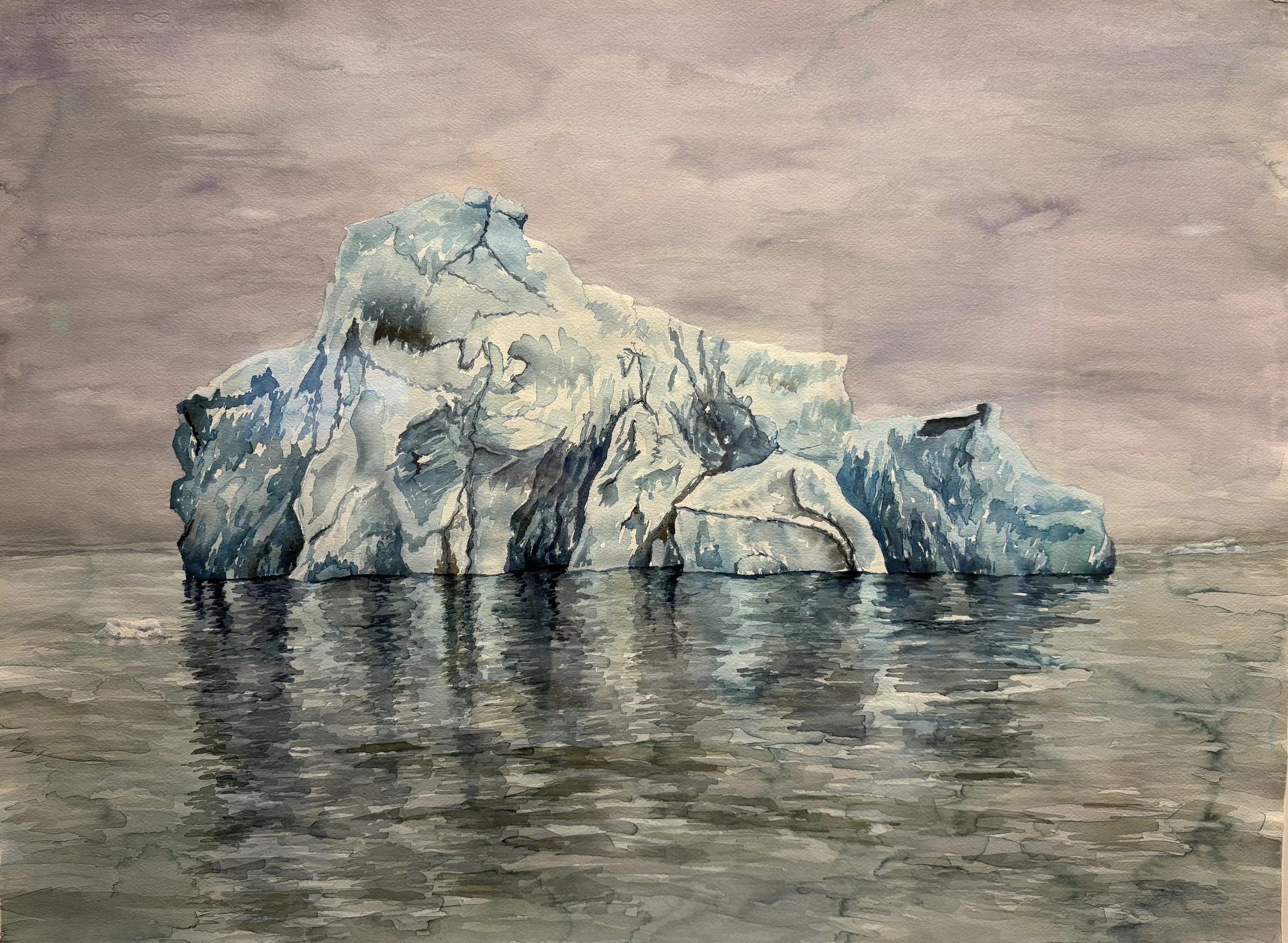
Professor Matt Frieburghaus' watercolor painting titled "Iceberg in Storfjorden."
Photo by Nicole Kreib '28
The Steel Plant Art Gallery wastes no time when it comes to presenting Marist University with incredible artists with fresh pieces.
Following the work of “Inverted Horizons” by two artists from Parsons School of Design comes a new exhibition on display, titled “You Had to Be There: Observations of the Arctic.” This show features work from 14 artists who have traveled to the Arctic to capture its fleeting environment, curated by one of Marist’s own professors, Matt Frieburghaus.
Frieburghaus, a professor of digital media with an interest in recording natural phenomena, became interested in the Arctic after completing a residency in Iceland in 2013, becoming captivated by icebergs and their fleeting nature. In 2022, Frieburghaus went on the Arctic Circle Residency, where he met several of the artists featured in the exhibition and gathered multiple media types to later create his work.
The Arctic Circle Residency is an annual competitive program where artists, scientists and educators of all disciplines and nationalities come together to explore the High Arctic Svalbard Archipelago. First introduced in 2009, this program supports pioneering work in hopes of empowering creative individuals. The gallery is composed of artists who had completed the program.
Two of Frieburghaus’ pieces are also on display. The first, titled “Albedo Affect,” is based on the phenomenon of a surface being able to reflect sunlight. It features two acrylic icebergs mounted to the wall with a video of an iceberg’s reflection projected onto them. This effect has become a crucial cycle to study because as ice continues to melt, the Arctic is warming up faster than other places in the world.
Frieburghaus’ piece presents the viewer with the idea that the memory of these icebergs is fleeting. The warming of our climate is not only changing these environments, but it is also erasing what was once there.
His second piece in the exhibition, “Iceberg in Storfjorden,” is a watercolor painting. Frieburghaus called the piece an “Iceberg Portrait,” with the intention of capturing the likeness of the iceberg. Continuing the theme of fleeting environments, the piece shows what the iceberg once looked like. Since ice continues to melt in the Arctic, you simply had to be there to witness what once existed in this space.
At the artist talk on Oct. 7, five of the 14 artists attended to speak about their work and give a glimpse of what it was like to travel through the Arctic, including New York-based artist Zelda Zinn.
With a background in photography, Zinn first traveled to the Arctic when she became overwhelmed by plastic consumption and was interested in capturing marine debris. However, upon arrival she realized these photos were uninspiring and came up with a new, obscure way of tackling the idea of climate change.
Featured in the gallery is her piece titled “Bergy Bits Rewilding Kits.” Zinn believes a great way to approach a difficult topic like climate change is to use humor. The “Rewilding Kit” is an ice tray shaped like icebergs, promoting a product where the consumer can “fix” the climate crisis by creating mini icebergs at home and setting them free back into the Arctic.
She also made five 3D models of different icebergs, once again selling consumers the idea of fixing what they broke by “Collecting All 5.” Finally, within her display are certificates to “own” icebergs. The certificates are sealed by some of the biggest names responsible for exploiting the world’s natural resources: J.P. Morgan, Andrew Carnegie and Commodore Vanderbilt.
Zinn’s humorous approach on the consumer’s impact on climate change and the human efforts to mess with nature led to the fun and playful creation of “Bergy Bits.”
Poughkeepsie local Kate Collyer, a professor in the printmaking program at SUNY New Paltz, was the last artist to speak at the event. Her piece on display, “I’ve Been Sitting on this Abandoned Beach for Years,” features screenprinted stained glass multiples in the shape of icebergs. Collyer traveled on the Arctic Circle Residency in 2016 and has backpacked through Greenland and circumnavigated Iceland — experiences that have become the focus of her work.
Her use of glass is essential in her work, often featuring the same characteristics as ice, except it is more permanent and resilient than the icebergs of the Arctic. Illustrating the idea of fragility, Collyer uses her work to mimic what she saw during her residency, reimagining what the scene looked like years prior.
Collyer, as well as the other artists in this exhibition, sit with the fact that this reimagination is the only thing giving their observations space. The melting of icebergs and the warming of our climate have permanently altered the Arctic. What these artists witnessed no longer exists.
The only thing remaining from observations is merely a memory. If you want to truly know what the Arctic looked like when the artists went, you just had to be there.
The exhibition is on display until Nov. 15, 2026.