“Halloween: The Game” Launches to Mixed Reception
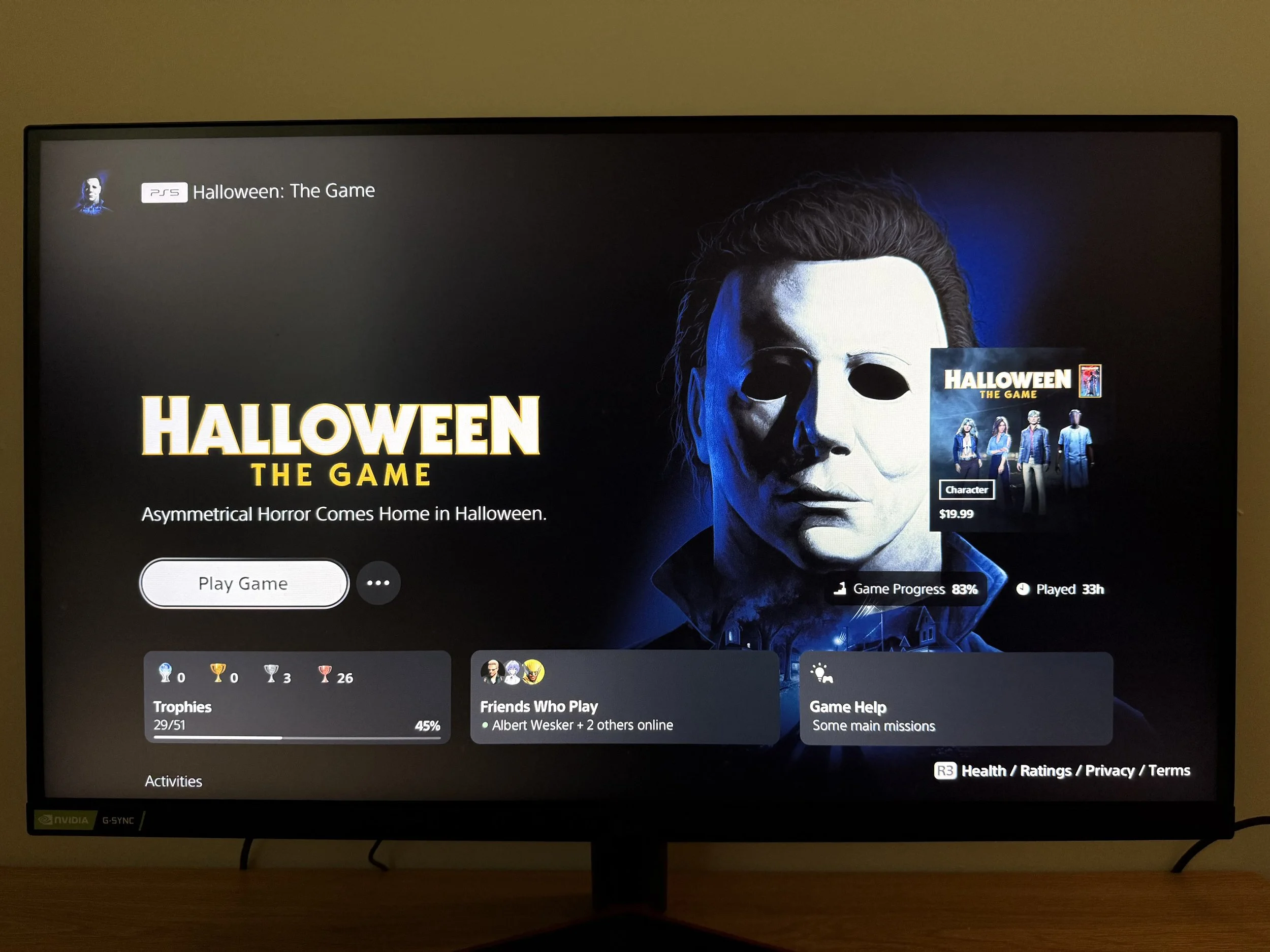
Home screen for "Halloween: The Game" on PlayStation 5. Nicholas Ferguson '28
“Halloween: The Game” (2026) has launched as one of the most controversial video game launches of 2026.
The new asymmetrical horror experience is developed by several studios, with the two standouts being IllFonic and Gun Interactive. These two studios are veterans when it comes to adapting horror movies into video games, most notably “Friday the 13th: The Game.”
The controversies with “Halloween: The Game” started before its release. Before the game’s launch, the slasher icon Michael Myers was in another popular asymmetrical horror game, “Dead by Daylight,” where the horror character was removed from its in-game shop. This meant that players who already purchased Michael Myers would keep him, but new players would not be able to buy the character.
On Sept. 4, 2026, “Halloween: The Game” entered early access. Almost immediately, controversies arose, with many players being stuck having to wait in long queues just to load in. A few days later, the queue times became less of a problem. But now that the game is officially out, people are starting to notice numerous issues.
“A single human plays the game for one lobby, and they be like, ‘Nothing works,’ so how does that get released?” said popular Twitch streamer xQc before advising players to avoid the game.
Despite the negative outburst, there are still a lot of people who are enjoying the new game.
“I’ve been having a blast; this game is everything I wanted it to be, and it has surprised me in so many ways,” said popular YouTuber JEV.
JEV is a fan of the developer's previous work and has been looking forward to the new release. Despite its issues, he seems to be really enjoying it.
The game has an interesting scoring system where the player controlling Michael Myers obtains points by killing players, but loses them for escaped civilians. If Michael has the higher score, he will win the game, but if he has a lower score, then the civilians win. Civilians can gain score by interacting with non-player characters across the map.
What makes this system interesting is that most asymmetrical games rely on how many players are able to escape the killer. But this system requires the players to work together to help the NPCs survive, making the NPCs' survival ultimately more important than players escaping.
Despite its importance, the NPCs’ function has been highlighted as a pain point for many players. Even though the game gives civilian players prompts to talk to the NPCs, allowing them to hide or follow you, they often do not follow player instructions.
The game also has glitches that have been frustrating players. After repairing a getaway car and trying to leave, it can suddenly lose all functionality. Since repairing the car takes a while and is a main escape option, it disadvantages civilian players who sink time into the option during the game’s valuable round time.
For those not interested in the online mode, the game also offers a single-player campaign. The campaign follows the events of the original film “Halloween” (1978) from the perspective of Michael Myers.
Although the campaign can be fun, its content feels shallow. It offers a mere six missions with solely cosmetic rewards. The campaign is short and could be finished in one to two hours, acting more as a tutorial than a standalone game mode.
There’s a feeling when you know something is bad, but you still cannot help but enjoy it. That perfectly describes “Halloween: The Game.” Even though this game has a lot of issues, it is still easy to overlook these and have a fun time.