Bad Bunny Makes History at Super Bowl LX
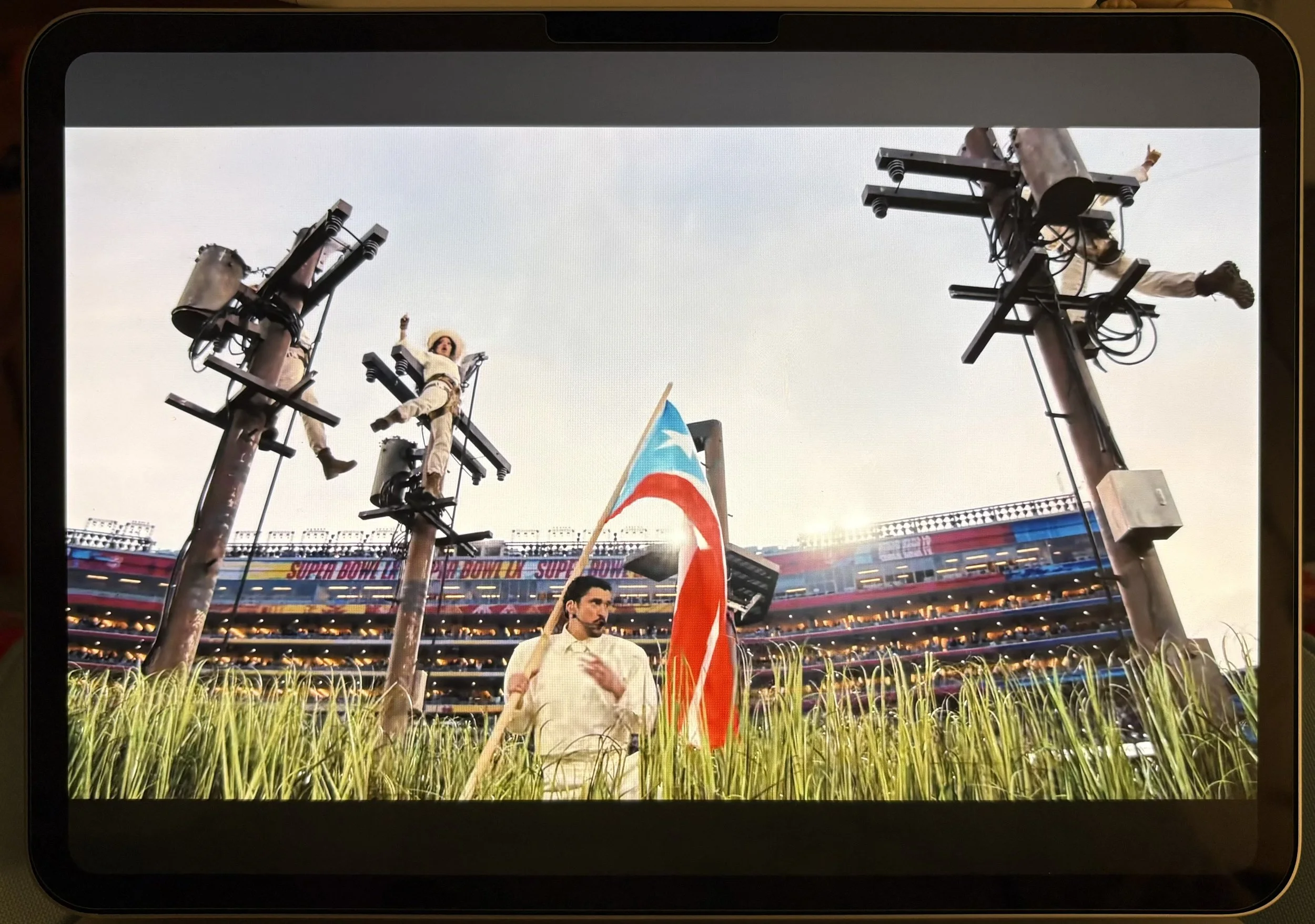
Bad Bunny performs at Super Bowl LX, highlighting Latin history, culture and resilience. Photo by Nicole Kreib '28
On Feb. 8, Levi’s Stadium in Santa Clara hosted Super Bowl LX. Many people tuned in for the football game, and even the commercials, but music fans patiently waited for the most memorable part of the night – “The Benito Bowl.”
Benito Antonio Martínez Ocasio, also known as Bad Bunny, headlined the record-breaking halftime show, bringing to the stage a performance full of Puerto Rican history, culture, values and resistance. Paying homage to his home, his set was packed with tradition, giving viewers a glance at the joy and identity of Puerto Rican culture.
“Having a Latino artist perform on major stages allows people from those communities to be seen and valued,” said Sophia Cadavid ‘27.
One week prior, Bad Bunny made history at the Grammys, winning three awards, including Album of the Year. His record, Debi Tirar Mas Fotos, is the first to win the award as an album entirely in Spanish.
But Bad Bunny did not stop here. His halftime show helped break the record for highest viewership in United States TV history, with 137.8 million viewers tuning in for the second half of the game and a total of 128.2 million viewers tuning in for his performance.
He opened his show with a prefilmed clip showcasing the lush fields of Puerto Rico before transitioning to his grand stage. The football field was filled with hundreds of people in grass costumes, creating a maze waiting to uncover what Bad Bunny had in store.
Nodding to the island’s colonial history, the audience was shown farmers chopping stalks in a sugar cane field. Puerto Rico’s indigenous people were forced into slavery by Spanish colonizers, and the sugar industry remains an important source for the island's economy.
Bad Bunny emerged wearing a custom leather football jersey designed by Zara, featuring his surname “Ocasio” on the back with the number 64, honoring his late Uncle Cutito, whom he never had the chance to take to a Super Bowl.
At the start of his performance, Bad Bunny walked through the field, passing vendors selling coco frio and piraguas, abuelos playing dominoes and women working construction. He ducked under two boxers and gave an engagement ring to a couple taken from a gold and silver stand.
Every move and display in this show was intentional, carefully thought out and delivered to the audience with precision. All the elements of the production were representative of tradition and culture connected to Puerto Rico, providing the audience with beautiful imagery of life on the island.
At the center of the vecindad, the neighborhood setting Bad Bunny created in Levi’s Stadium, was a casita featuring celebrities such as Pedro Pascal, Cardi B, Jessica Alba and Karol G, along with others, to bring the classic Puerto Rican house party to life.
Then the show transitioned to a couple tying the knot on another stage set. Yes, a couple really did get married in front of millions of people on live television. The couple had originally sent an extra wedding invitation to Bad Bunny, not expecting a response. Instead, Bad Bunny took it to the next level and asked them to get married during the halftime show.
This brilliant idea showcased the purest form of love and unity. Following Bad Bunny’s speech at the Grammys, where he demanded “ICE out” and stated, “The only thing that is more powerful than love is hate.” This was the greatest form of resistance towards the current administration and American political landscape.
Accompanying the wedding was Bad Bunny’s first special guest, Lady Gaga. She performed a salsa rendition of her hit single “Die With a Smile.” The newlyweds and others danced as she performed, and Gaga ended her appearance dancing with Bad Bunny, illustrating yet another united front between musical artists.
The most touching moment of the entire halftime show was when Bad Bunny gave one of his Grammy trophies to a young boy. The five-year-old sat watching his acceptance speech before being handed the trophy.
The little boy represents a young Bad Bunny, wearing a striped collared shirt and khaki shorts. However, some fans believe he represents Liam Ramos, the young boy who was detained by ICE on Jan. 20.
Even if this is not the case, the scene was intentional. Showing a young boy in a performance centered on belonging and love is crucial to Bad Bunny’s message.
“Instead of Bad Bunny criticizing ICE, he chose to celebrate Latin culture proudly and unapologetically. He chose to humanize our community and show others that we are vibrant, resilient and an essential part of the United States of America,” Cadavid continued.
Bad Bunny continued to wow his viewers by bringing in a second musical guest, Ricky Martin.
The Puerto Rican singer sat alone as he sang, “Lo Que Le Paso a Hawaii.”
Translated to “What Happened to Hawaii,” this song discusses how Hawaii and Puerto Rico were taken by the United States in 1898, with Hawaii becoming a state and Puerto Rico becoming a commonwealth. But his song explains how he does not want this fate for Puerto Rico.
This song can be seen as the most politically driven portion of the show. Having his guest singer perform it, an artist who had to sing in English to rise to fame, pushes Bad Bunny’s message further about the Latin community in America.
As the show came to an end, people ran through the field holding flags of every country in North, Central and South America.
“God bless America,” Bad Bunny shouted, before naming every country that makes up the Americas.
“I was able to hear the countries where my parents were born and raised. It created a sense of unity and pride and even made me feel more connected to the show,” said Cadavid.
He took the football he held on to tightly throughout the entire performance and faced it to the camera with it reading, “Together We Are America.” Behind him, a jumbotron reads “The Only Thing More Powerful Than Hate Is Love,” the same declaration he made at the Grammys.
Bad Bunny marked a major cultural milestone for Hispanic representation. He created a celebration of America’s diversity, proving that we are more powerful when united. The Latin identity is deeply rooted in America, and Bad Bunny’s performance highlights its continued presence amid the current political climate and debates over representation.
Fans remain hooked, spreading the joy of the performance and its cultural impact. Hispanic representation did not start with, nor will it stop with Bad Bunny. His historic show reminds the world of the beauty in diversity and will drive inclusion in America.