“Lee Cronin’s The Mummy”: Blumhouse Unearths Mediocrity Once More
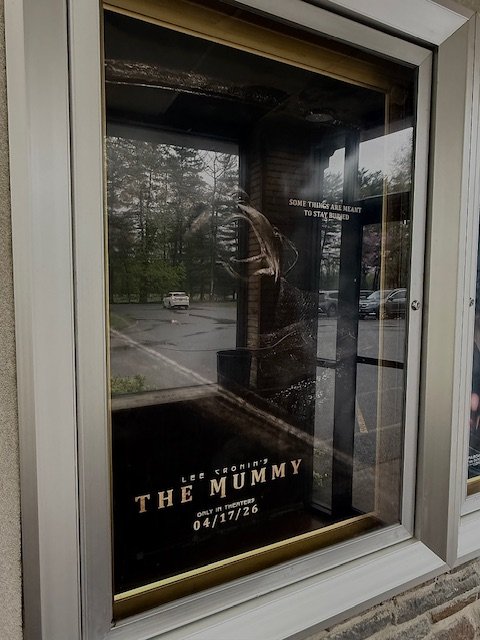
Rising director Lee Cronin stamps his fingerprints on this latest reimaging of the classic movie monster. This review looks to uncover the vision behind Cronin’s rendition, the originality within this project, and whether or not it leaves something unique to the viewer apart from other retellings. Photo by Aidan DeMatteis '28
One of many characters born from Universal Studios’ roster of iconic movie monsters, the Egyptian Mummy has been faced with various interpretations on the silver screen dating back to its debut. Tossed around between an original Hollywood trilogy starring Brendan Fraser and a large-scale, action film starring Tom Cruise, this icon has gone through the underworld and back to receive a proper reimagining within modern filmmaking.
The license has now fallen into the hands of director Lee Cronin, working alongside Blumhouse Studios and producer James Wan, backing the project. Most notably, the mind behind “Evil Dead Rise,” the latest installment in the long-running Evil Dead franchise, Cronin gets the latest crack at the apple of bringing a unique approach to the classic monster.
“Lee Cronin’s The Mummy” sets itself in its own distinct universe separate from all other Mummy franchises. Molding its individual identity, the film draws away from a horror adventure film like most, fully committing to the supernatural horror surrounding the titular character.
The question then arises of whether this tonal approach works for the film’s success or turns out to be its ultimate detriment.
The film is set in Egypt, following a family whose young daughter was kidnapped. It is not until eight years later that she is found mummified, soon reunited with her family as they take her back home.
The story does not end there, as their decaying daughter soon begins to transform into something horrific that should have stayed dead and buried.
“Lee Cronin’s The Mummy” certainly delivers a vastly different approach to the monster, whether it be from its horror, confined narrative, or visual style. Lee Cronin displays an intentional, creative reimagining in his final cut; an idea that meaningfully sets itself apart from previous Mummy films and molds itself into a gutsy, almost unrecognizable interpretation.
At the cost, Blumhouse has only unleashed another vengeful spirit of mundane horror into the modern day. And while fingers can be pointed as to who is at fault, it is ultimately both the creative mind and the studio that backed them who carry out this underwhelming result.
As previously stated, the film still holds weight when it comes to the main revisions orchestrated by Lee Cronin that overshadow its shortcomings.
Firstly, the film presents an impactful, atmospheric soundtrack composed by Stephen McKeon. The various tracks successfully elevate the moments of tension and horror, adding intrigue within each sequence that keeps the viewer that much more engaged.
For another significant positive, performances are all serviceable across the board. For characters that are, for lack of a better term, run-of-the-mill characters, the actors are able to do a lot of heavy lifting that adds a bit more levity to the overall film.
One actress who makes a major standout is Hayat Kamilie, playing the character only known as the Magician. While her role is not necessarily front and center within the story, her performance as the main antagonist leaves the audience wanting more screentime with her following her strong impression.
With that being said, there is not much else from this recent rendition that sets it apart as a monumental, unique reinvention of the classic movie monster.
At the face of its issues, “Lee Cronin’s The Mummy” features an unfocused, cluttered script that completely derails the narrative. Piecing together the entire story from an overhead view, there are many times when it loosely ties itself together or feels incomplete, disorienting the viewer’s experience when attempting to follow along.
This film could have benefited from a thorough revision to fill in these clear gaps.
Adding salt to the wound that is the film’s story, at multiple points, the film asks the audience to suspend their disbelief and to not question its logic. It is when the audience notices these lapses in logic that it severely breaks down their immersion, bringing the whole structure down with it.
To cap it all off, the biggest offense of “Lee Cronin’s The Mummy” is its major identity crisis when it comes to its style of horror.
Cronin does not shy away from going extremely grotesque and brutal with the gore, reminiscent of his work in the Evil Dead franchise. However, due to the film’s reliance on its gruesome style as the driving element behind its horror, it can quickly wear off for those who find it effective.
The real punch in the gut is what “Lee Cronin’s The Mummy” could have done for a struggling studio like Blumhouse. Lee Cronin showcases the capabilities and confidence of a strong creative mind, someone who revels in getting under audiences’ skin and is trusted with complete creative control over his projects.
But at long last, another reimaging of the classic movie monster morphs into yet another example of horror mediocrity.