The A24 Expansion: A Reposition from Independence to Mainstream
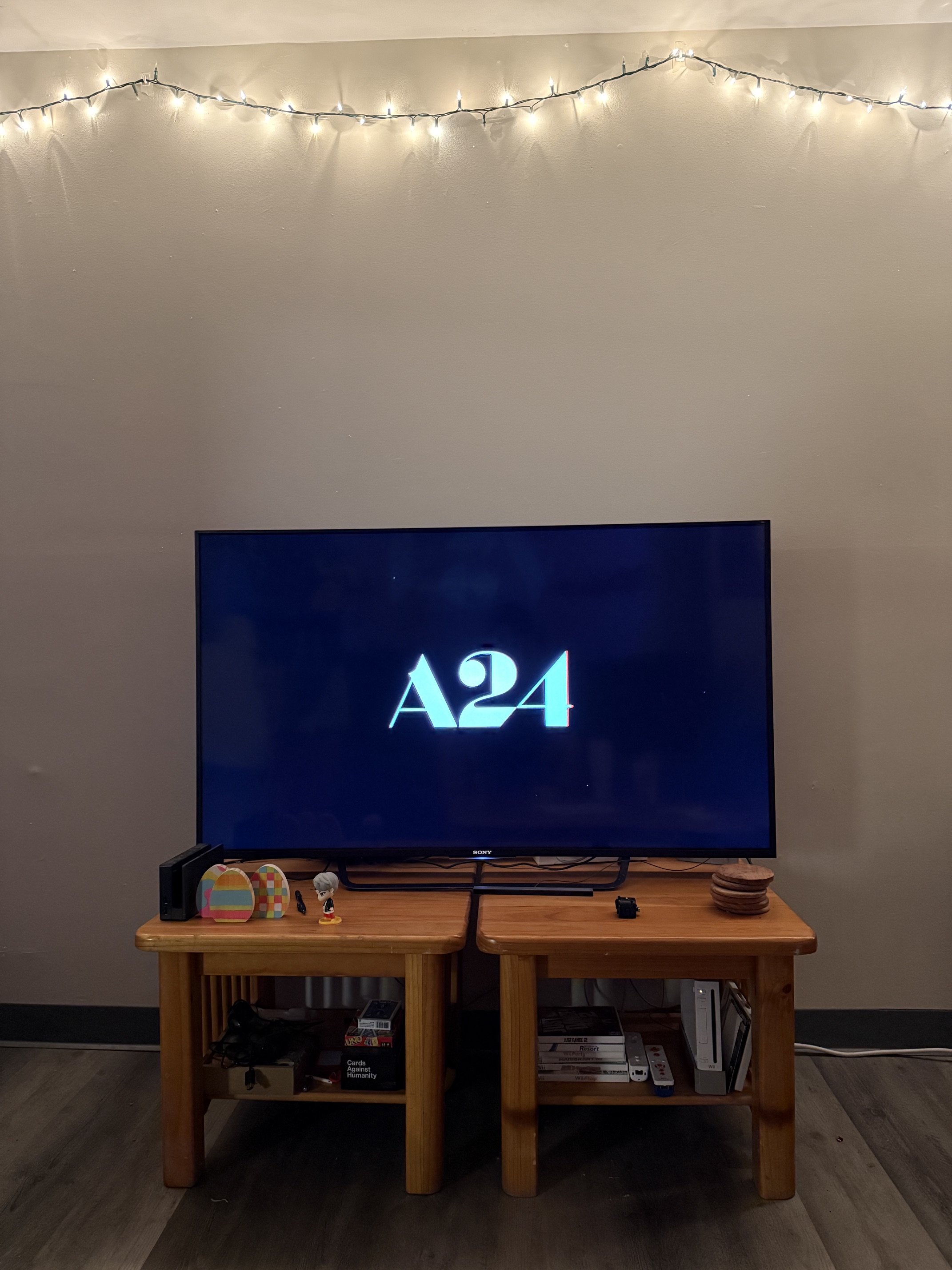
For much of the past decade, the dominating independent film studio originally found its jive through its low-budget, condensed productions that resulted in high acclaim towards their business. As they have continued to branch out, it seems they have aligned with the loud showbiz they once opposed. Photo by Aidan DeMatteis '28
Ever since its first few steps into the film industry, A24 Films LCC, universally named A24, has been at the pinnacle of independent video production over the past decade.
Where 21st-century films have long followed the practices of mainstream Hollywood, often featuring large budgets, star-studded casts and partnering with strong distribution companies, A24 would stray away from these tried and true methods in favor of their own, autonomous approach.
Rather, it was their condensed budgets, their will to take fliers on aspiring filmmakers and actors, and their abstract, distinct projects that would propel them to grand prosperity and recognition from the public. Its major hits, the likes of “Moonlight,” “Hereditary,” and “Everything Everywhere All At Once” as its more notable projects, would surpass their low budgets at the box office and reach the heights of Oscar awards.
They were seen as the epitome of consistency within the modern film space.
Since then, indie filmmaking has evolved into a much more prevalent force in the film industry, following the company’s emergence, an example for aspiring creators of what could be accomplished in the independent field of media production.
Looking to the present, as the company has continued to branch out into more independent productions, a glaring commercial shift in quality has also followed in their footsteps.
Of its most recent releases and announced projects within the past calendar year - with behemoths of “Marty Supreme” starring multi-time Oscar nominee Timothee Chalamet as the studio’s most successful film to date, or approaching releases with “Backrooms” as Kane Parsons’ directorial debut and “The Death of Robin Hood” starring Hugh Jackman - they have all undergone shared permutations of bigger budgets and popular actors.
However, this was not A24 surrendering to the practices of the mainstream Hollywood movement.
It was back in 2023 when A24 announced their alternation in strategy from concise, arthouse style to a more commercial, publicized approach.
In an article from The Wrap by Umberto Gonzalez and Drew Taylor, the motive behind this switch was provoked from their desire of “‘doing more,’ which includes looking at wide releases and ‘widening the aperture'".
Subsequently, the studio’s aspirations would be greatly supported, receiving a $3.5 billion valuation funded by Thrive Capital in June of 2024, a staggering 40% increase from their previous valuation.
While general concerns were sparked for how this would impact A24’s original identity, which has built its mass following, the studio has found its footing through a change in the guard while reinforcing its brand in the modern day.
Closely examining their recent track record, the studio’s optimization of large budgets has led to immense box office results in comparison with the past.
Take, for instance, the Academy Award-winning drama, “Moonlight,” which ran on a budget of around $1.5 million before hitting $65 million in return; one of the lowest budgeted films to have ever won Best Picture in the history of cinema.
Turning the page only a decade later, their newest productions have faced significant increases in budgeting with larger turnouts from the box office as a result.
The biggest paragon of this trend is “Marty Supreme” directed by Josh Safdie (one of the two Safdie brothers who have previously partnered with A24), which estimated between $60-70 million in funds before going on to achieve a whopping $191 million worldwide. To this day, the intense sports comedy-drama remains A24’s highest-grossing film in their existence.
But at the cost of granting larger funds for their productions, the studio has distanced itself from its ground roots of arthouse, experimental filmmaking in favor of grounded, simplistic stories.
Take, for example, the studio’s largest grossing films from global audiences, with the top 5 placements featuring the aforementioned “Marty Supreme” as the king of the hill, the dystopian war journalism film of “Civil War” directed by Alex Garland, and the rom-com splashes of “The Drama” from Kristoffer Borgli and “Materialists” from Celine Song occupying the bottom two spots.
The only arthouse-centric film that has long held a spot on this list is the bizarre sci-fi of “Everything Everywhere All At Once,” which took home multiple awards from the 2022 Oscars.
The initially skeptical commercial shift has turned out to have struck more worldwide audiences, but with a slight disinclination from their original indie movement of arthouse filmmaking at its cost.
In closing, the question is not about the change from independence to mainstream being an objectively right or wrong decision.
The cult-like following A24 has built since its inception stemmed from their experimental mindset, partnering with independent creators to bring their ideas to the silver screen and moving mountains to support the independent realm of filmmaking.
Now with their subtle change in direction, time will tell whether this comes to their long-term benefit or detriment.