“The Odyssey”: The Historical Epic Turned Summer Blockbuster
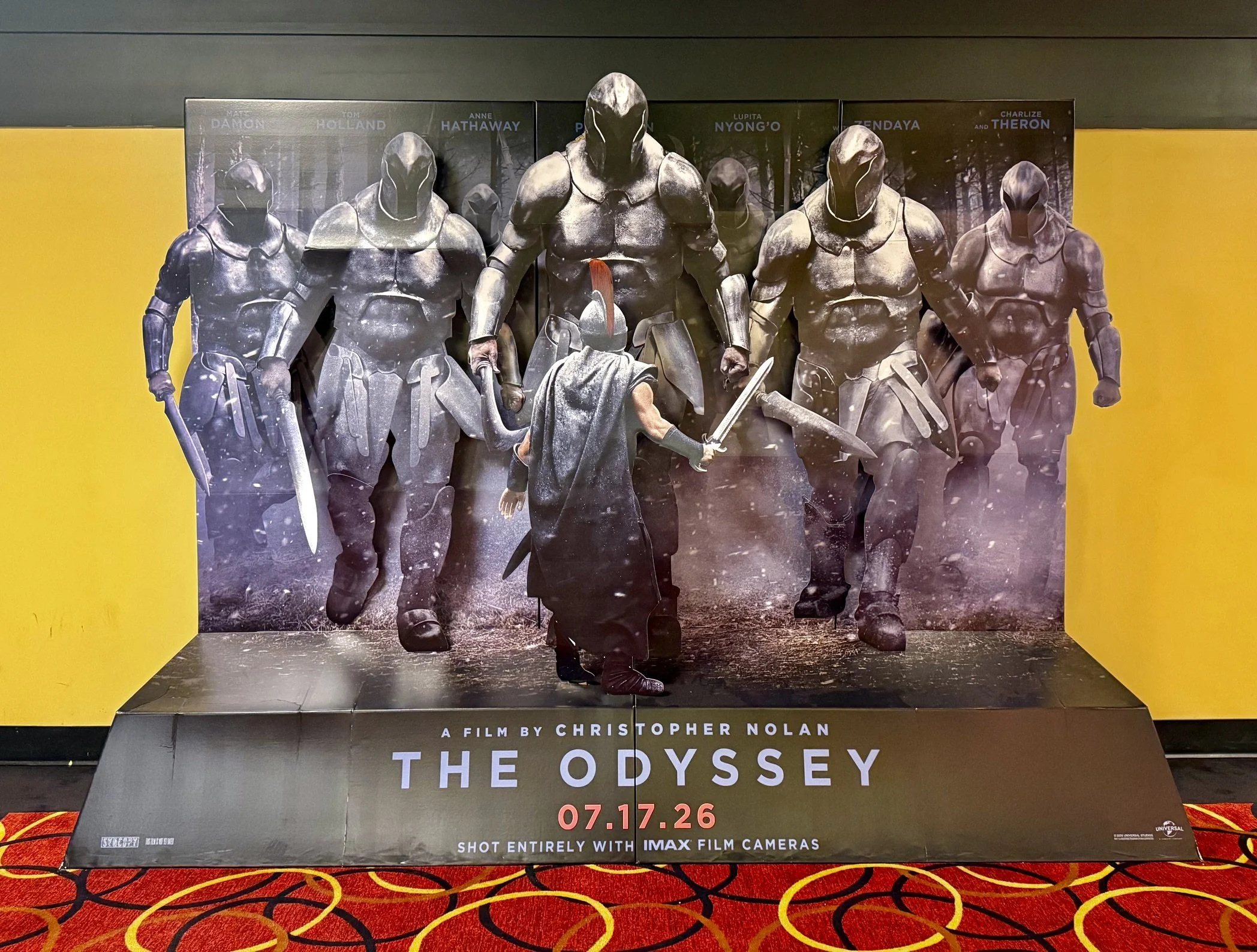
Cardboard cutout of the official poster for The Odyssey.
“The Odyssey,” the fictional Greek epic poem written by Homer in the eighth century B.C., has long remained a foundational work of Western literature. Centuries later, Homer’s piece has received countless adaptations, most recently with Christopher Nolan adapting the epic into a feature film.
The original story follows Odysseus, king of Ithaca, venturing back home from the Trojan War with his soldiers, enduring various obstacles within the world of Greek mythology at every corner of their journey.
Nolan’s “The Odyssey” serves as almost an exact retelling of the original poem, with the plot centered around Odysseus’ voyage back home to Ithaca to reunite with his wife, Penelope, and son, Telemachus.
Nolan has done more than carve out a successful career for himself. From celebrated works such as “Interstellar” to multi-award-winning statements in “Oppenheimer,” his warped concepts, nonlinear storytelling and grand-scale productions have earned him a reputation as one of the best directors of his era.
In late 2024, Universal Studios announced that the acclaimed director would be taking on the new challenge. Fortunately, Nolan has not lost his stride, only picking up where he left off and doing everything that makes his films jive.
A trait that carries across most of Nolan’s films is immersing the audience in larger-than-life environments through locations and camera techniques. For a large portion of the first two acts, the film ventures between different environments that help illustrate an ancient Greek world.
Each set piece, complemented by the manipulation of foreground and background play within various shots, only escalates the world-building necessary to bring the viewer into this story.
The cinematography plays right into these exact production qualities. “The Odyssey” is the first feature film shot entirely with IMAX 70mm cameras. Compositions featuring wide establishing shots of settings or an epic battle sequence that thrusts the audience into the middle of the conflict allow viewers to escape into each major moment, amplifying the film’s scope and scale.
“The Odyssey” features an ensemble cast of A-list celebrities to fill each major character from the original story. Anne Hathaway portrays a more despondent Penelope, yearning for the return of her husband and delivering strong emotions at the center of her character.
Robert Pattinson as the film’s lead antagonist is a standout, acting as slimy and cowardly as possible for the audience to root against him. The same applies to Samantha Morton as the witch Circe, leading one of the film’s best yet disturbing scenes with shorter screen time.
Nolan flashes a few new film tricks, specifically with the iconic Cyclops segment. Almost transformed into a horror sequence, the practical effects used to make the one-eyed giant come to life, along with some of the most chilling sound design you could hear in a theater, allow Nolan to unveil a hidden eye for horror directing and craft a monumental scene.
That being said, there are a few notable hiccups that slightly anchor the film. Many of the supporting characters rarely come to serve a larger role than they were set up with. Despite Charlize Theron and Zendaya being cast as significant figures within Greek mythology, they appear in only a few scenes and do not return to properly fuel the climax. This unfortunately plagues many other supporting characters.
The most damning issue of all is that, while Homer’s epic is meant to be a hero’s journey with the protagonist growing and enduring as they continue on their path, Nolan fails to capture the full idea of growth within his adaptation.
Matt Damon works as a more traumatized yet stubborn Odysseus, but these changes to his character rob him of his agency and undersell his supposed arc. In short, it is a hero’s journey void of one.
Reaching the end of this exploration, “The Odyssey” stands tall as yet another Nolan success in an already stacked filmography. Taking the work of Homer that has stood for centuries, the end result is a fantastical, entertaining feature for the summertime.
Nolan could be in the running for Best Picture at the upcoming Academy Awards once more.