Trump Takes Back the White House
The former president won the 2024 presidential election, with reactions from Marist students and predictions of forthcoming policy following suit.
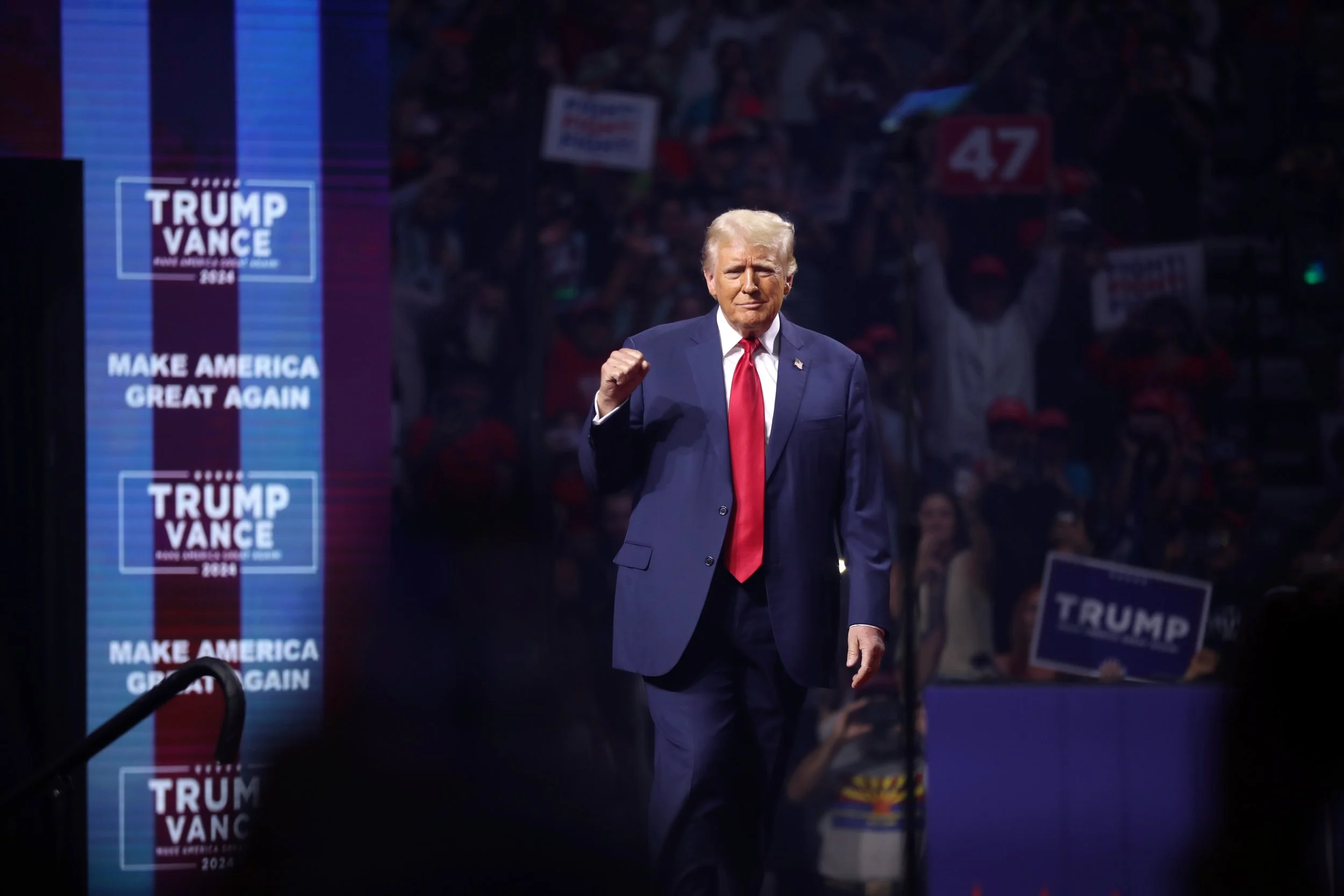
Donald Trump is confirmed to be the 47th President of the United States of America. Photo by Gage Skidmore via Flickr.
Former president Donald Trump will serve a second term as the 47th president of the U.S., according to a race call by the Associated Press.
After winning swing states Pennsylvania and Wisconsin, worth 29 electoral votes combined, Trump received the 270 votes needed to win the presidency. AP called the race in his favor on Nov. 6 at 5:34 a.m. ET.
Trump held a watch party in West Palm Beach, Florida, where he spoke to a crowd of supporters with his family and staff.
“We made history for a reason tonight,” said Trump, prior to the race being called. “We overcame obstacles that nobody thought possible.”
For the first time in his campaign history, the former president won both the 270 electoral votes and the popular vote, contrary to his first presidential campaign in 2016, when he won the Electoral College, but lost the popular vote to Democratic opponent Hillary Clinton by 2.9 million votes.
Trump will be the first former president to serve a separate second term since 1892, as well as the first convicted felon to serve as president.
On Thursday, Trump announced Susie Wiles as his White House Chief of Staff. Wiles served as Trump’s co-campaign manager and will be the first woman to hold the title of Chief of Staff. She has worked in politics for over 40 years, first starting when she joined Ronald Reagan’s 1980 campaign.
Republicans won control of the U.S. Senate early Wednesday morning. The GOP currently has 52 seats, and the Democrats have 44. Control of the House of Representatives has yet to be determined, with 23 races waiting to be called as of Nov. 9.
Trump’s opponent, Vice President Kamala Harris, conceded the race Wednesday afternoon at her alma mater Howard University.
“On the campaign, I would often say, ‘When we fight, we win,’” Harris said in her concession speech. “But sometimes, the fight takes a while.”
Harris’ campaign was unprecedented, as she did not start running in the race until July 2024 after President Joe Biden announced he would not be seeking re-election. He endorsed Harris in his announcement and within the first week after announcing her campaign, Harris raised a record-breaking $200 million.
“Don’t ever give up. Don’t ever stop trying to make the world a better place,” she said, addressing young voters. “You have power.”
There were 40.8 million members of Gen Z eligible to vote in the election, according to the Tufts University Center for Information & Research on Civic Learning and Engagement. Of the 40.8 million, 8.3 million aged into the electorate since the 2022 midterms.
In key swing states, young people, particularly young men, played a crucial role in the election. National exit polls found that 49% of men under 30 years old voted Republican, compared to 41% voting Republican in the 2020 presidential election.
Trump and Harris proved to have a close race ahead of the election. Recent polls showed the two candidates separated by only a few points in swing states like Pennsylvania, Arizona and Wisconsin and tied at 49% in Georgia.
The inauguration ceremony will take place on Jan. 20, 2025 in Washington, D.C.
Reactions from Students
Marist College students have mixed reactions following the 2024 presidential election.
Marist Democrats treasurer Azalea Clickenger ‘25 was surprised and “devastated” by Trump’s victory.
“I didn't expect these results because I wanted to have hope. I wanted to believe in the campaign that Kamala Harris was running, and I couldn't fathom that the United States population as a consensus could [elect] a man who’s been convicted of felonies,” Clickenger said. “I thought we knew better now.”
As a left-leaning moderate, Aidan Parascando ‘26 also voted for Harris and was upset with the outcome.
“I have never been so scared following an election,” said Parascando. “I went from shock to disgust, and now I'm just really disappointed because I've always espoused getting along with people that you don't agree with, but this election just feels so dramatically different from everything before.”
One student Trump voter, who chose to stay anonymous, credits concerns about the economy with his decision.
“We've already had a Trump administration, and inflation was at a 40-year low. My mom has a job because of Trump — his tax cuts on big businesses allowed her position to remain open in her company, and it kept her job, whereas for the last four years, she's been fretting about layoffs,” he said. “So that's one of the big reasons why I voted for Trump.”
Although he doesn’t agree with the Republican Party’s approach to abortion, social issues were overpowered by economic concerns in this election.
“We've had a Trump administration before, and no one lost their rights, like a national abortion ban didn't happen. So for me, that was less of a concern. For me, this is kind of going back to a 2016 America, I'm not really concerned with his social policies,” he said.
As of early October, Trump claimed he wouldn’t support a national abortion ban as president. However, Trump has been praised by pro-life organizations for being the “most pro-life president” for his appointment of three conservative Supreme Court justices that helped overturn Roe v. Wade.
For Parascando, Trump’s victory is a loss for abortion and reproductive rights.
“Issues like abortion are going to be pretty much locked in now that Trump's been elected because the Supreme Court is primarily Republican, and he can appoint more people to reinforce that,” Parascando said.
Foreign policy was a major concern on both sides.
“I worry that [Trump’s] buddies in China and Russia are going to mean bad things for Ukraine. Also, his taxes on foreign imports, I don't think are beneficial for the economy,” Parascando said.
Other social issues were also a major concern for voters. A second term with Trump’s inconsistent and overall negative approach to LGBTQ+ rights worries members of the community and LGBTQ+ allies.
“I'm worried for my friends, my peers, everyone. I'm scared for people close to me that I know will be affected by hateful rhetoric, especially in the queer community,” Clickenger said.
Though some students didn’t find Trump’s victory surprising, many were surprised by the former president winning the popular vote.
“I had a gut instinct that he might sweep the swing states, but I did not expect him to get the popular vote at all. I expected there to be another 2016 situation where he wins the Electoral College but loses the popular vote,” the anonymous source said.
Despite some local Democratic wins like Rep. Pat Ryan defeating Alison Esposito, Clickenger believes this massive loss should be a wake-up call for the Democratic Party.
“The Democratic Party needs to revamp its entire position on everything. Like Bernie Sanders said, the party aiming to appeal to the working-class families is not supported by working-class families,” Clickenger said. “I think this is a serious point of reflection, and it's an opportunity for us to rethink what being a Democrat and what being left means.”
Presidential Policy Predictions
When Trump takes office in 2025, he will bring with him a Republican presidential administration likely to be filled with unprecedented firsts in national politics. From creating detention camps for migrants and deploying the National Guard in cities with crime to prosecuting violators of abortion bans and pardoning those involved with the Jan. 6 U.S. Capitol attack, the “more assertive and confident” president-elect is expected to take the reins of the federal government.
He offers several economic proposals, such as instituting 10-20% foreign good tariffs and initiating spending plans that would contribute significantly to the national debt. He also hopes to deport millions of undocumented immigrants in a massive campaign and to champion a ban on gender transition care. Other potential policies include eliminating federal funding for schools that engage with Critical Race Theory and possibly using confiscated private university endowment money for an online college academy with “no wokeness…allowed.”
According to Time Magazine, his allies aim to align themselves with the Unitary Executive Theory, a theory of constitutional law that gives the U.S. president singular command of the executive branch. Moreover, Trump has signaled that he would support his former Schedule F appointment policy, which would give him permission to fire nonpolitical officials should they not follow through on his proposals.
With financial benefits for Tesla and SpaceX hanging in the balance, Trump supporter Elon Musk is slated to lead a new government efficiency commission, while Robert F. Kennedy Jr. might serve in the administration as a “health czar.” Although Kennedy is known for his fondness for vaccine misinformation, he has indicated that he would not take vaccines away from people.
In addition, Trump does tend to align himself with right-wing figures in the international political arena. He previously met with Hungarian Prime Minister Viktor Orban in July, with Orban now calling Trump’s re-election a “much-needed victory.” And as told by veteran journalist Bob Woodward’s latest book “War,” it is possible that Trump spoke privately on the phone to Russian President Vladimir Putin several times after his first term. For his part, President Volodymyr Zelensky of Ukraine said that Trump’s claim to end the Russo-Ukrainian War in a day would not be feasible without a loss for his country.
Still other policies are sure to bring unprecedented change. This could potentially include the recommendations found in “Mandate for Leadership,” a regularly released election cycle document produced by the conservative Heritage Foundation think tank. The latest version — deemed Project 2025 — proposes, among other things, to delete the term “diversity, equity and inclusion,” to remove the Department of Education and to privatize National Weather Service forecasts. While Trump publicly said he doesn’t know anything about the project, the Heritage Foundation itself reported that Trump implemented two-thirds of the mandate’s 2017 version in the first year of his first term.
Furthermore, Trump emphasized during the Sept. 10 presidential debate that abortion is an issue that should lie in the hands of the states to determine restrictions at their will, as opposed to introducing a full ban on the federal level. When it comes to climate change, Trump is not a fan of embracing the severity of the century’s primary environmental crisis. He intends to reverse the tax incentives of President Joe Biden’s billion-dollar Inflation Reduction Act, to “drill, baby, drill” and to again withdraw the U.S. from the Paris Agreement treaty that commits the world to greenhouse gas emissions reductions.
With Republicans now in the Senate majority, Trump’s agenda will probably not face much pushback on the congressional level, and potential vacancies in the Supreme Court might also allow him to fill the country’s highest court with additional judges who remain consistent with his stances. But until then, a divided nation holds its collective breath — either in anxiety or anticipation — as Trump soon steps into the White House once again and prepares to make his mark on the national stage.