Dutchess County Awarded $20 Million to Pilot Child Care Program
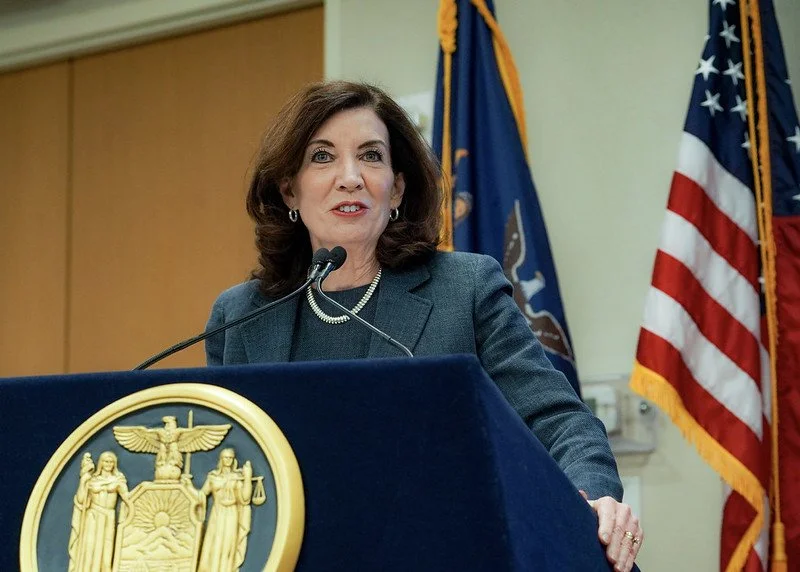
Gov. Hochul makes historic announcement that Dutchess, Broome, and Monroe counties will pilot a new child care program. Photo courtesy of the Metropolitan Transit Authority via Flickr
As part of a $4.5 billion statewide initiative to expand access to universal child care, Gov. Kathy Hochul announced that the State would partner with Dutchess, Monroe and Broome counties to pilot the program. Under the plan, each county will receive a $20 million investment for its pilot, with the counties contributing an additional 10% in funding.
Set to begin in 2027, the pilot will build upon existing county-led efforts to create affordable, year-round, full-day care, aiming to support up to 1,000 seats for children under the age of three in each county.
The historic announcement took place at DAY ONE Early Learning Center in the City of Poughkeepsie, New York, where Gov. Hochul joined local leaders, elected officials and young students to unveil the pilot program.
“We know the value of centers like [DAY ONE], how life-changing they can be,” said Hochul. “But for too many families, it is just too big a barrier.”
Many families live in what is known as child care deserts, defined by the New York State Office of Child and Family Services as “not having enough licensed/registered child day care slots to adequately serve the number of children in a geographic area.”
The problem is further exacerbated as funding shortages force more centers to close. Such was the case for the North East Community Center in Millerton, which announced in November that it would be closing its Early Learning Program amid financial challenges, leaving families scrambling.
Jill Gomez, executive director of the Poughkeepsie Children’s Cabinet, noted that in addition to funding, proper support of the workforce is one of the biggest obstacles to reliable child care.
“Many early childhood learning professionals and staff are not making a thriving wage,” said Gomez. “And so that makes it really hard to have longer-term pathways, either into the teaching profession or into leadership positions or just to have stable teachers.”
A February 2025 report from State Comptroller Thomas P. DiNapoli noted that in 2020, the number of day care service jobs in the state dropped by 19.8%. The number recovered by 2023, but only in New York City and Long Island, not in the rest of the state. According to a 2021 report by the U.S. Treasury, turnover in this sector equated to around 26 to 40%, with many reporting high levels of burnout and stress.
Providers cited low pay as a significant hurdle to attracting and retaining staff. In 2024, the median wage for those working in the child day care services sector was $37,675, which is $20,000 less than the median wage for all New Yorkers. In addition, many child care workers do not receive added benefits, such as employer-provided health insurance, paid time off or pensions.
The Poughkeepsie Children’s Cabinet is among numerous local organizations praising the selection of Dutchess as one of the three pilot counties, citing its unique location and robust existing infrastructure.
“It's definitely not an accident that Dutchess County was selected,” said Gomez. “There's a lot of leadership in the early childhood space that's happening here in both the local government level, as well as the provider level and advocacy space.”
“Here we have urban, suburban and rural environments convening all in one place,” said Himali Pandya, executive director of the Child Care Council of Dutchess and Putnam, Inc. “You also have people who are living or working in New York City, and those who come from upstate. It is such a wide variety of the population that is served in one location, and we can learn from each one of them.”
Both believe that the pilot program will impact children and parents in Dutchess alike.
“One of the most important things is the social-emotional learning that is done in these environments, especially because the most brain development happens in this stage [ages 0-3],” said Pandya.
Evidence suggests that access to high-quality childcare is linked to healthy social-emotional development, teaching kids early on how to manage their emotions, productively express strong feelings, develop empathy and form and maintain relationships. Additionally, it correlates with the development of language, key to future academic success.
Increased access to child care will positively benefit parents as well, specifically mothers. In the absence of affordable and reliable services, the responsibility falls disproportionately on women, most notably women of color. They, in turn, must leave their jobs – losing not only a source of income, but an opportunity for advancement in the workforce as well.
“In order for caregivers, and particularly mothers, to be able to participate fully in the economy, they need to have secure, trustworthy, safe, stable and consistent child care,” Gomez said.
Hochul echoed this vision in her address.
“Women will take their rightful places as contributors to their family income but also to the economy of their community,” said Hochul.
In addition to the pilot programs, Hochul is also setting aside an additional $1.2 billion for the state’s Child Care Assistance Program, which provides subsidies for families, and is investing approximately $500 million to expand universal pre-K.
With each county facing its own unique set of needs, she hopes the pilot program will offer the data needed to make the appropriate next steps.
Hochul said, “That’s what this is all about – the ripple effect of all this, it’s extraordinary.”