Trump Announces Two-Week Ceasefire with Iran
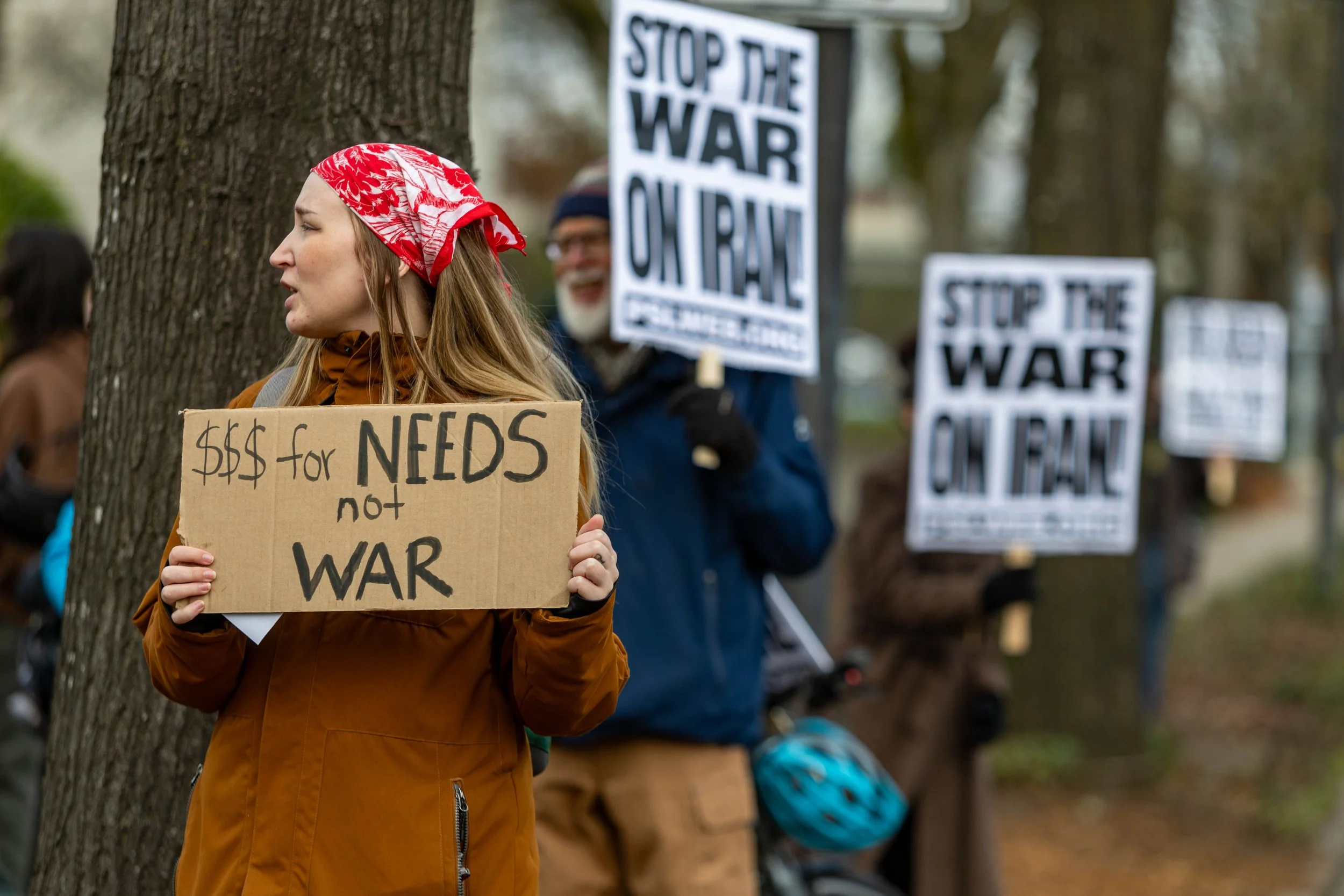
U.S. protests against the war. Photo via David Geitgey Sierralupe on Flickr
Following the U.S. and Israel’s joint attacks on Iran in February, President Donald Trump announced a two-week ceasefire. Previously, Trump has been hesitant to explicitly state clear reasoning and expectations regarding the end of the conflict. Meanwhile, public approval of the war and of Trump has drastically decreased.
The ceasefire deal gives Iran and the U.S. two weeks to negotiate a permanent end to the conflict. Though no agreement has been publicly released, according to statements made by both Trump and Iran’s Supreme National Security Council, the deal outlines an end to all attacks from the U.S. in Iran and a halt to Iran’s defense tactics. Both countries have released plans with differing demands, including control of the Strait of Hormuz. Negotiations are set to begin on April 10.
Iran's strategy has been to restrict access to the Strait, a waterway connecting the Persian Gulf and the Gulf of Oman, through which about 20% of the world’s oil passes. During the conflict, at least 24 commercial trade ships have been hit.
Before the ceasefire deal on April 7, Trump threatened Iran in a Truth Social Post, saying, “A whole civilization will die tonight, never to be brought back again. I don’t want that to happen, but it probably will…47 years of extortion, corruption and death will finally end. God Bless the Great People of Iran!”
In another Truth Social post, Trump outlined his conditions for a ceasefire deal. “We will consider when the Hormuz Strait is open, free, and clear. Until then, we are blasting Iran into oblivion or, as they say, back to the Stone Ages!!!” he wrote.
The restrictions on oil have caused gas prices to skyrocket since the start of the war. The price of gas in the U.S. has increased 27% a year and 21% from last month. This is due to the high price of Brent crude oil, the international standard, which rose to $107 a barrel.
This is a top concern for Americans already dealing with a high cost of living. According to a Pew Research Center study, 69% of Americans are concerned about higher gas prices because of the war. These concerns are bipartisan, with 79% of Democrats and 59% of Republicans expressing worry.
Since the announcement of the deal and the Strait reopening, oil prices have fallen nearly 15%. Brent crude oil dropped to $93.48 a barrel. Stocks have also risen, with the Dow Jones Industrial Average gaining more than 1,000 points.
Trump has faced criticism following his threats against civilian targets in Iran before the ceasefire. Former Rep. Marjorie Taylor Greene, a former Trump ally who resigned from her position in Congress in November, called for his removal from office. “25TH AMENDMENT!!! Not a single bomb has dropped on America. We cannot kill an entire civilization,” she said in a post on X. “This is evil and madness.”
Since the initial attacks on government and military sites in Tehran, Iran has retaliated by targeting U.S. military sites in the region. Over the five-week conflict, 13 U.S. service members have died. In the United Arab Emirates, 12 people were killed, 2 of which being U.S. soldiers, after Iranian attacks on a U.S. military base. Seven people have been killed in Kuwait, three of whom were civilians. In Iran, 3,540 people have died, including 1,616 civilians.
However, there is still a long way to go to achieve peace, according to Iran’s Supreme National Security Council.
“It is emphasized that this does not signify the termination of the war,” the council said in a statement. “Our hands remain upon the trigger, and should the slightest error be committed by the enemy, it shall be met with full force.”