President Trump's Remarks About Pope Leo XIV Compromised American Catholics
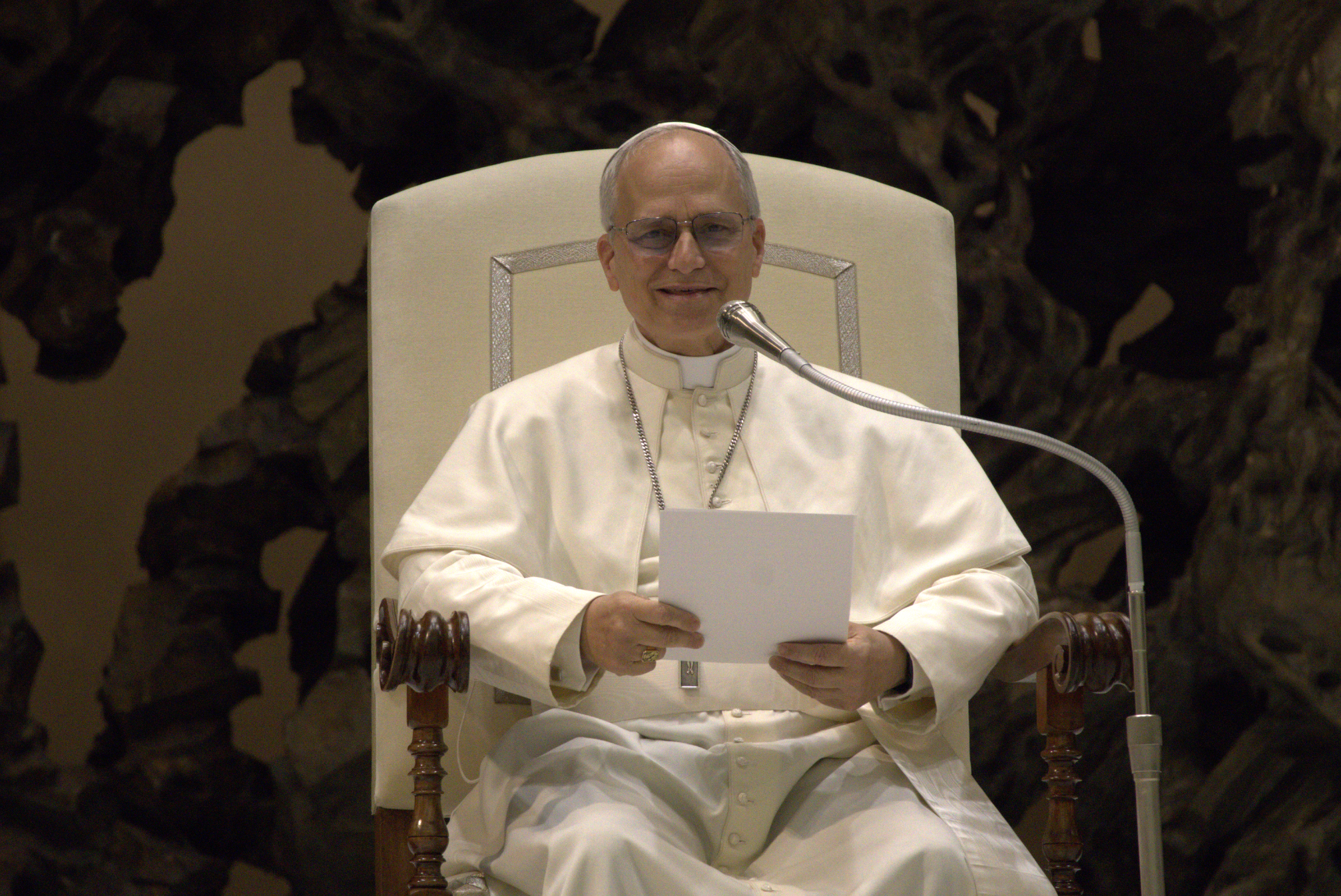
Pope Leo addressing representatives of the media for the first time on May 12, 2025 in Vatican City. Photo by Edgar Beltrán via Wikimedia Commons
President Donald Trump has entered a feud with the Vatican. Amidst the war in Iran, Trump and Pope Leo XIV have engaged in a back-and-forth exchange of remarks via interviews, public appearances and social media.
A timeline from USA Today traces the dispute with who has said what so far, but the origins of the dispute begin Easter Sunday, April 7, when Trump shared a Truth Social post that declared “A whole civilization will die tonight,” threatening another attack on Iran.
The same day in an interview, Leo referred to these threats as “unacceptable,” marking the first exchange between Trump and the pope.
Following the ceasefire deal temporarily halting the war, Leo stated in a post on X on April 8, “Only by returning to negotiations can the war come to an end. #Peace.”
Additionally, at a peace vigil held at St. Peter’s Basilica at the Vatican on April 11, Leo called on world leaders who have “binding responsibilities,” and advised them to "Stop! It is time for peace! Sit at the table of dialogue and mediation, not at the table where rearmament is planned and deadly actions are decided!"
These remarks from Leo culminated in a Truth Social post from Trump on April 12 calling the pope “WEAK on Crime, and terrible for Foreign Policy.”
In the same post, he also said, “Leo should get his act together as Pope, use Common Sense, stop catering to the Radical Left, and focus on being a Great Pope, not a Politician. It’s hurting him very badly and, more importantly, it’s hurting the Catholic Church!”
Also on that same day, Trump posted a now-deleted AI-generated image depicting himself as a Christ-like figure healing someone with the touch of his hand.
Responding to Trump, Leo stated on April 13 aboard a plane to Algeria that he does not want to get into a debate with Trump, and that, "I have no fear of the Trump administration, or speaking out loudly of the message of the Gospel, which is what I believe I am here to do."
Trump’s direct call-outs to Leo signify an unprecedented territory with a feud between a U.S. President and the leading figure of the Catholic Church.
Trump’s attacks on the pope and the AI-generated image of himself as a Christ-like figure have offended many American Catholics, possibly impacting Trump’s relationship with this sector of the American population.
According to the Pew Research Center, Trump won the Catholic vote in the 2024 election against Kamala Harris 55% to 43%, and four years prior, Joe Biden took the Catholic vote over Trump by a small margin, with a 50% to 49% Catholic vote. There is a historical affinity between Catholics and Trump, as shown by these numbers.
Dr. Sally Dwyer-McNulty is a Professor of History at Marist University who occasionally teaches the course Catholics in the U.S.
When asked about how reactions to Trump’s remarks about the pope and the AI-generated image he posted inform how the Catholic faith still holds influence today, Dwyer-McNulty said, “It’s actually even beyond Catholic culture. Certainly, what I’ve heard and what I’ve read, Catholics are offended. But also, I would say people identify as Catholic in some capacity, like a cultural Catholic, they are offended.”
NPR interviewed several Catholics from Chicago, the pope’s hometown, who shared their reactions to Trump’s feud with the pope.
One individual named Colin Powell stated, “I am a Catholic first for 70 years. You know, Roman Catholic, no matter what.”
Catholics in Miami have also grappled with this feud, with Miami Archbishop Thomas Wenski stating, “the pope doesn’t have to please anybody except the Lord.”
Additionally, Marjorie Taylor Greene, a notable Conservative figure, former representative for Georgia's 14th congressional district, and Evangelical Christian, weighed in on the Trump controversy.
In a post on X, Greene referred to the AI-generated image of Trump as “blasphemous” and criticized those who attempted to defend his actions.
“But others who just admire the pope, who are not Catholic, are also offended. The offense goes all wide,” said Dwyer-McNulty.
Leo, being the first American pope, adds an interesting, perhaps personalized dimension to this feud for American Catholics.
“People that kind of have a very close relationship with the Catholic Church or a very distant relationship with the Catholic church, I think they have an affection for him. Some people call him ‘Bobby’ or ‘Bob,’ he has this warmth to him,” said Dwyer-McNulty.
The pope, being a Villanova graduate and a self-proclaimed Chicago White Sox fan, adds a sense of familiarity with the American people, possibly leading them to resonate more with this influential individual.
“He seems to be a person that lots of people, regardless of being Catholic, respect him,” said Dwyer-McNulty.
This unusual feud between Trump and the pope has left American Catholics and Christians at an awkward crossroads with the president. If anything has come about from this dispute, it’s that faith holds a significant weight for the identities of millions of Americans, and when this is compromised, the people react.