Hudson Valley Librarians are Pushing Back for Banned Books Week
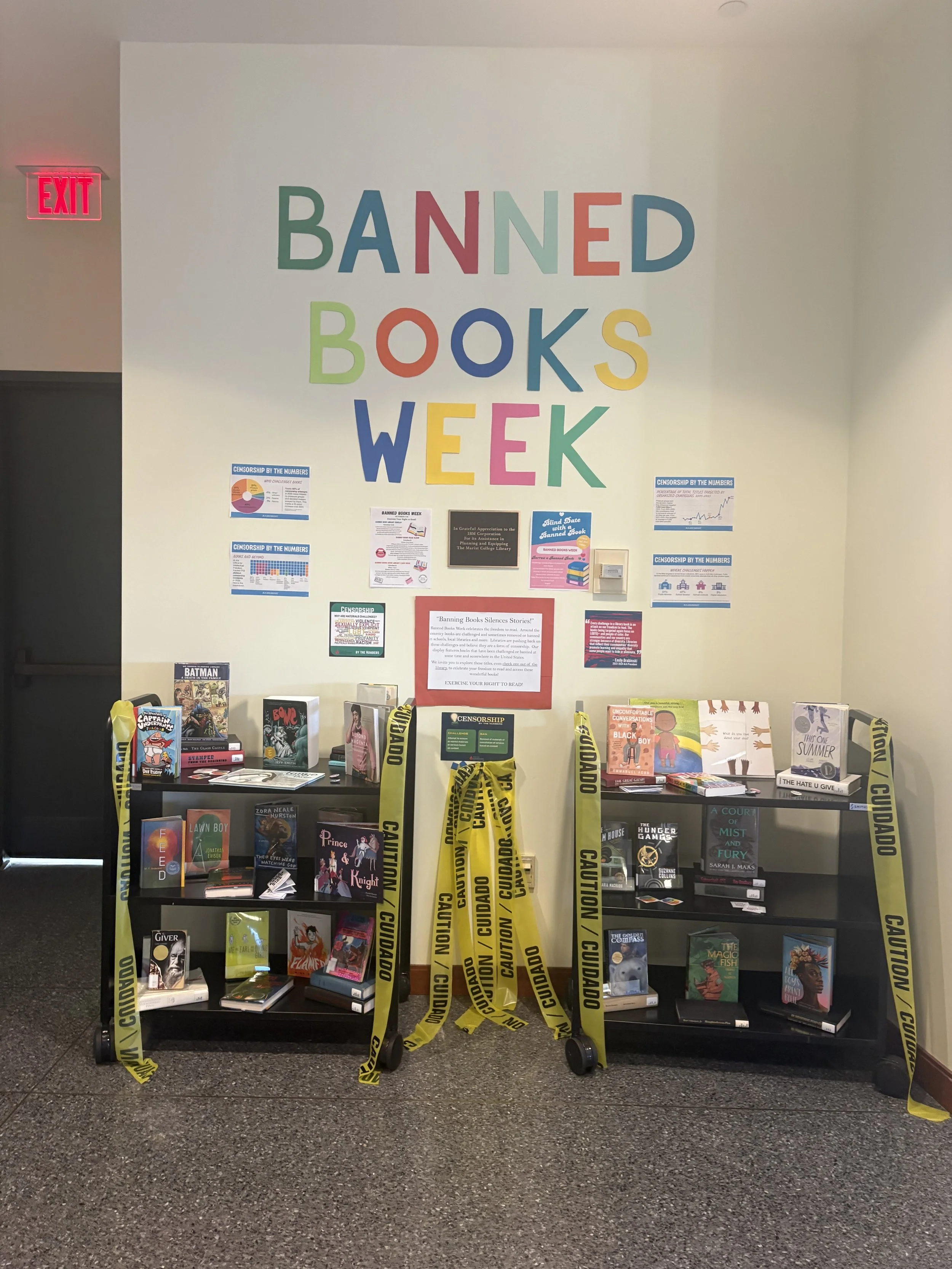
The Banned Books display in the James A. Cannavino Library allowed readers to learn more about banned and challenged books.
Photo by Kate Chorbajian '27
Literature is an outlet for individuals to share stories, connect with others, convey beliefs and promote social change, but the increase in book bans across the country threatens readers’ freedom, representation and education. During the 2025-26 academic school year, 11,982 book bans affecting 7,370 unique titles were recorded in public schools. This is the highest number of recorded bans since PEN America began tracking banned books in 2021.
To counteract the increase in banned books — which reached a record high in schools last academic year — the Banned Books Week Coalition brings together the entire book community to highlight free and open information through Banned Books Week. This annual, week-long event highlights the importance of protecting the freedom to express ideas.
This year, Banned Books Week ran from Oct. 4 through 10. The theme was “Let Books Be. Protect the Freedom to Read.”
Libraries across the Hudson Valley held events in support of the week, including Marist University's James A. Cannavino Library. Elizabeth Clarke, coordinator of library instruction, and Gill Friedlander, public and research services librarian, organized two events during the week to encourage Marist students to participate in raising awareness.
The events consisted of a Banned Books Read-Aloud on Oct. 6 and a Banned Books Week Library Card Drive on Oct. 8.
The Library Card Drive allowed people to sign up for public library cards virtually all across the country. From San Diego and Seattle to New York City, Clarke and Friedlander helped students connect with various libraries nationwide.
“Even if you can’t get to a library, you can still support a library,” Friedlander said.
The Poughkeepsie Public Library District also held events throughout the week. Megan McGuinness, youth services librarian at Adriance Memorial Library, coordinated a children’s book display and read-aloud event for children ages 3-8.
“Here at the library, we really believe in folks having the freedom to read,” McGuinness said. “That means that families and kids get to choose the books that they like best. We believe that every kid should get to explore stories that feel right for them.”
To maintain these freedoms, Clarke and Friedlander encouraged community members to get involved at a local level, which often starts at public libraries.
“Be aware about what’s happening at your public library and your school district,” Clarke said. “If people have been removing things from the shelves, fight back. So much can be done by the community pushing back against people challenging things or wanting things removed.”
According to McGuinness, no books are currently being challenged at the Poughkeepsie Public Library District. If a challenge were to occur, McGuinness said the library would follow a formal policy for reconsidering material.
“We don't just pull a book off the shelves because we decide that we don't like it anymore,” McGuinness said. “We pull a book off the shelves because it's no longer valuable to the community anymore. We're stewards of this community resource, and we take that seriously.”
In 2025, 92% of all book challenges were initiated by government officials or pressure groups, up from the previous record of 72% in 2024. Less than 3% of challenges originated from individual parents.
“Many times these challenges are not coming from parents,” Clarke said. “They are coming from other folks who don’t have children at all, or folks who feel this goes against what they believe, so they would like it removed even though they are not being required to read it or forced to read it.”
Clarke and Friedlander emphasized the importance of readers of all ages to see themselves represented in pages. Both librarians have observed an increase in challenged books involving LGBTQ+ identity and critical race theory.
Friedlander added that reading challenged books is also important to building empathy and connections.
“Your story matters and someone else's story matters and everybody has a place here,” McGuinness said.
“Denying people access to information and knowledge and correct information is dangerous and it allows people in power to dictate the narrative,” Friedlander said.