Marist’s Approach to Safety from Gun Violence: Do Students Feel Safe?
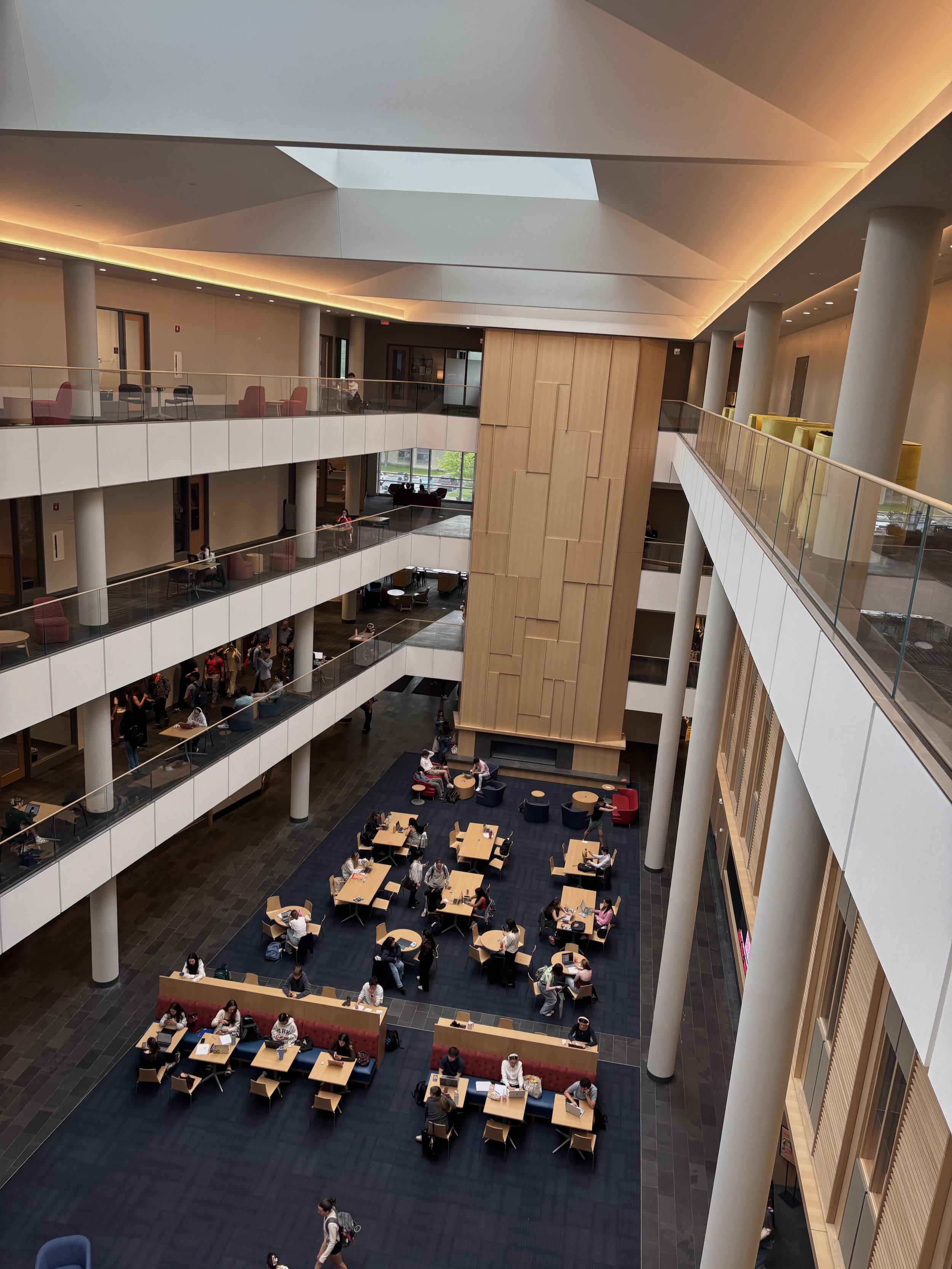
Open design of the new Dyson Building. Photo via Jacquelyn Drain '27
Due to the rise of gun violence on college campuses, some Marist University students have expressed dissatisfaction with the emphasis placed on campus safety. This comes after the completion of the Dyson building renovations in 2024, with an open-concept design consisting primarily of glass.
So far in 2026, there have been eight shootings on college campuses, with gun violence now categorized as a national health crisis. A study conducted in 2023 found that 65% of college students said school shootings impact their sense of safety on campus, and 63% favored stricter gun policies on campuses. This contributes to 75% of college students feeling moderate or severe psychological distress.
“There’s a shooting on a college campus almost every other week,” said Daniel Gough, director of Safety and Security. “We have, because of the prevalence of armed intruders and active shooters on campuses, put a great amount of time and focus on responding to active shooters.”
In the event of an incident, Gough is confident in the system they have in place. The protocol in place requires Marist security officers, who are unarmed and unsworn, to approach at a safe distance and confirm initial reports. Meanwhile, a dispatcher monitors the surveillance systems and relays information to the responding officers.
However, Marist students and faculty are not exempt from the stress surrounding gun violence. Olivia Weinbaum ‘27, a psychology student, spends four days a week in the Dyson building and has frequently thought about safety.
“I feel that the glass walls and open doors make it easy for intruders to come in and know that there are people in the building,” said Weinbaum.
Dyson has a large front atrium and two side entrances. The classrooms include glass doors and large floor-to-ceiling windows without shades or privacy. According to Gough, the layout was created for energy efficiency purposes. These elements create an open design, but also a sense of worry for some students.
“There is little to no protection in the building in the case of gun violence,” said Weinbaum.
Gough, who came to Marist in 2024, was not present for the design of the building. “I don't know that I would have made a recommendation for not having glass for aesthetic reasons in the building,” he said.
The building was designed by Annum Architects, a company based in Boston, Massachusetts. In the original design published by Annum, a security desk was placed to the right of the front entrance. This desk was never added during construction.
Safety concerns go beyond just the Dyson building. Marist campus lacks security and swipe access for non-residential buildings, and any vehicle can access the campus without going through a security checkpoint. While efficient, anyone in the Poughkeepsie area could drive into or walk onto the Marist campus without identifying themselves.
“It is a little scary that anyone can enter campus without having to show identification,” said Weinbaum. “There is no form of security at any entrance.”
Adding security checkpoints to entrances is not currently under active consideration.
Gough said, “Yeah, we certainly consider that. Is it a possibility in the upcoming? I don't see it in the near term. But that's not to say that it's not possible. We’re always reviewing the risks and weighing changes in our security posture on campus.”
For Gough, this is a personal concern following the shooting at his alma mater, Brown College, at the end of 2025.
“It's also especially impactful for me as a campus safety professional, as an emergency management professional, as a higher ed professional and as a parent of a daughter who just recently graduated from college,” he said.
“We're working on moving from reactionary to preventative with a number of different technologies, but, you know, the campus grounds are open,” said Gough. “There’s public access to our buildings.”