“An Evening with Aasif Mandvi:” Using Humor to Navigate Today’s Society
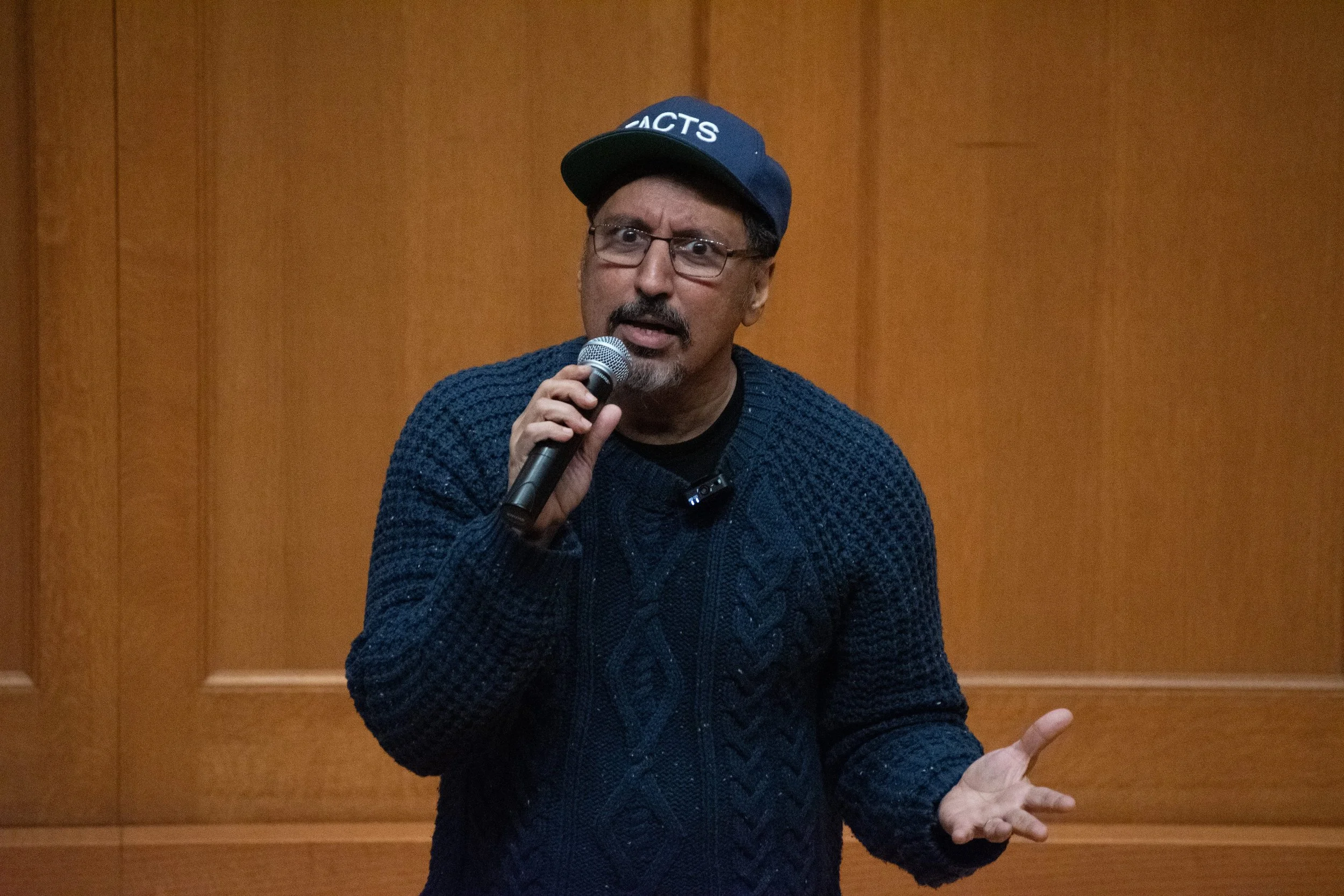
Aasif Mandvi speaking to members of the Marist community in Fusco Hall. Photo by Lilian DeFilippis '26
“It is perhaps the last bastion of human resistance, to tell stories,” Aasif Mandvi said in response to an audience question about the importance of connecting with people through storytelling.
Mandvi, famous for his time as a correspondent on Comedy Central’s The Daily Show with Jon Stewart, his critically acclaimed one-man show Sakina’s Restaurant and his small yet beloved role in Sam Raimi’s Spider-Man 2, set the bar high, opening Marist University’s Spring 2026 Lecture Series with a humorous and engaging performance.
The event occurred on Jan. 28 at 7 p.m. in the Fusco Recital Hall and resembled a comic’s routine. Mandvi was as humorous as he was profound in discussing today’s changing society. He spoke about navigating the entertainment industry as a brown man, drawing on stories from both his childhood and his career.
“My book is called No Land’s Man. It was going to be called My Meteoric Rise to the Middle, but my editor didn’t want to go with that title,” Mandvi said. “But it doesn’t matter how successful I am; I still get mistaken for other brown actors. A decade ago, there were only two brown actors in Hollywood, and now there are eight.”
Though born in Mumbai, India, Mandvi stated, “My parents decided when I was a year old that we would move to the great industrial coal mining town of Bradford, England.” He knew from a very early age that he wanted to be an actor, a dream that clashed with both cultural expectations and societal limitations.
“My father, of course, as all Indian parents did, wanted me to grow up and be a doctor. But his reasoning was not what you would expect,” Mandvi joked. “He actually hated the English. He said we are here in their country to get them back for what they did. He was the only Indian dad who wanted his son to marry an English girl and have half-English kids as an act of resistance.”
“So when I told my parents that I wanted to be an actor, I might as well have just said I want to be a grapefruit because they were just like, yeah, no, people can’t become grapefruits,” he said.
Before the lecture, Mandvi met with students and faculty at a pre-event dinner in the Dining Hall’s quiet dining room. He reflected on the evolution of his work there. “This is actually one of my first gigs in a long time,” Mandvi said. “You guys are a little bit of guinea pigs on material that I’m going to do.”
When questioned about the importance of creative or nontraditional career paths such as film, television and theater, Mandvi replied, “The world is changing at such a fast pace. All of the sort of things that inspired me and my generation to follow your passion with the thing that you know that you love doing, and you’ll spend all of your time trying to do it. I hope that’s still true.” He added, “I don’t know anymore if it’s true.”
He paused before adding, “It’s going to change, it’s going to evolve, you know? My kid is five, and he’s learning coding. I don’t know what advice to give you other than just follow your passion.”
In an era defined by uncertainty and rapid change, Mandvi returned to the guiding principle of his career and comedy.
“What I do is try to tell stories and humanize people,” Mandvi said. “Because I think, ultimately, that is how we change the world, how we change culture.”