Yale Professor Delivers Lecture on Harlem Renaissance to Marist University Students
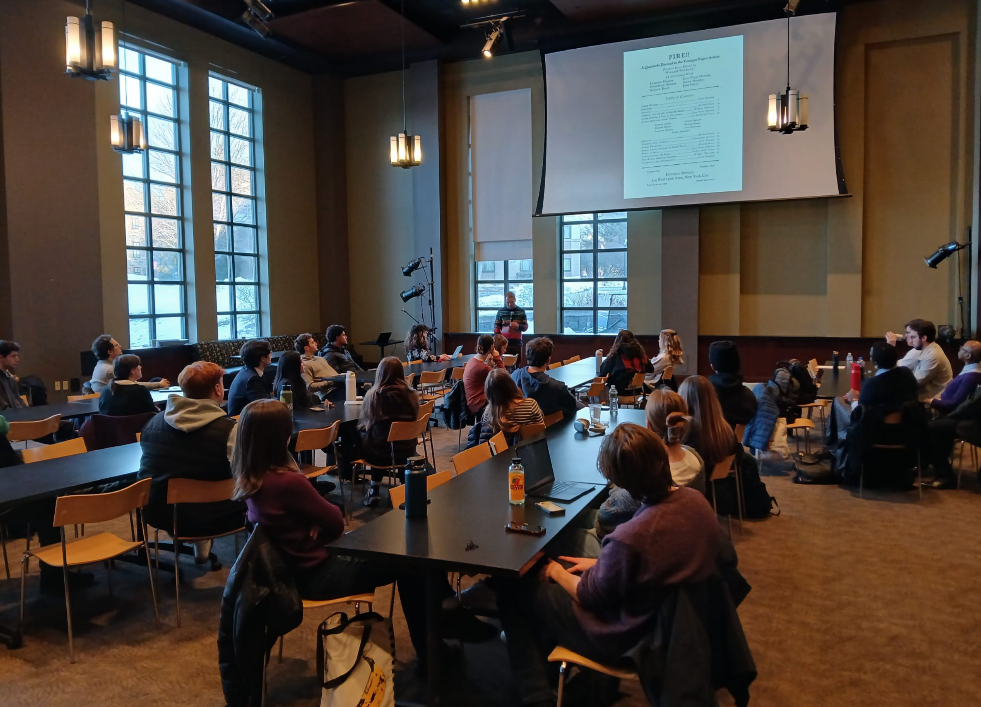
Students in the Cabaret listening to Dr. Shane Vogel's lecture on the sensuous poets of the Harlem Renaissance. Photo by Dr. Gabriel Chagas
On Feb. 26, Professor of English and Black Studies at Yale University, Dr. Shane Vogel, delivered a talk about the sensuous poets of the Harlem Renaissance to Marist University students. Hosted by Dr. Gabriel Chagas, the event celebrated Black History Month and was also part of the Africana Studies Seminar Series.
Vogel specializes in the Harlem Renaissance and talked to students and faculty about how the Black body was being portrayed through a new, celebratory lens in the 1920s United States.
Dr. Chagas, Assistant Professor of English at Marist, hosted the talk to correlate with the contents of his upper-level English class, “African American Voices,” but also opened the lecture to the entire academic community.
During the talk, Vogel emphasized the revolutionary nature of the Harlem Renaissance as it promoted a new sense of self for Black Americans, was steeped in queerness and sexuality and challenged existing racial stereotypes in the United States.
Vogel dissected selected poems from Harlem Renaissance poets such as Langston Hughes, Helene Johnson, Countee Cullen, Carrie Williams Clifford and many others to show how this new ideal of blackness was taking form within the nation.
Vogel challenged those in attendance to unlearn a lot of what we think we know about the Harlem Renaissance, Black culture and U.S. history in general.
As the lecture focused on the sensuous poets of the Harlem Renaissance, those who played on the senses in their work, Vogel highlighted some tropes and themes common throughout Harlem Renaissance poetry.
Vogel spoke in depth about the idea of “laughing boys” and “dancing girls,” an image that portrays Black joy and celebration.
In “Laughers,” a poem by Langston Hughes, Hughes highlights the beauty of Black laughter, which Vogel described as “a sound in itself,” attributing a sense of agency to the action of laughing.
In another Hughes poem, “Jazzonia,” Hughes presents the image of a Black woman dancing in a Harlem cabaret in a “dress of silken gold.” This woman symbolizes Black joy as she revels in the scene of this jazz club.
Dr. Chagas explained the significance of Black Americans being portrayed in this uplifting way. “The history of the diaspora has been marked by this very deep, very harsh and profound relationship with bodies that were considered to be objects and commodities.”
For Harlem Renaissance poets, writers, artists, etc., their work served as a way to revitalize the image of the Black body that is so often associated with profit and pain.
“Langston Hughes wrote a lot about lynching, which was a very present phenomenon in the 1920s and 30s, but at the same time as Dr. Vogel demonstrated in the talk, you have all these writers reimagining the black body,” said Chagas.
Talking more specifically about laughter, Chagas said, “Laughing is something that we need to possess control of our own bodies to do. Black laughter has been historically represented and used as an interruption of the racial violence of the Black body.”
Vogel also focused on queer themes within Harlem Renaissance poetry. Poems from Angelina Weld-Grimké, Alice Dunbar Nelson and Carrie Williams Clifford both explicitly and implicitly proclaim love and yearning for other women, opening conversations about sexuality in early 20th century America.
Vogel also highlighted the literary publication “Fire!!,” started by Zora Neale Hurston, Langston Hughes and Richard Bruce Nugent, amongst many others. This magazine was an outlet for Harlem youth, was rooted in sexuality and promoted a new sense of Blackness.
Chagas talked about how many modern issues have presented themselves throughout history and highlighted this when talking about the Harlem Renaissance and sexuality.
“For example, the LGBTQ+ community. People think that conversations of race, place of origin, and gender within the LGBTQ+ community are something very current and it’s happening all the time, and yes, it is very important, but it has been happening for 100 years.”
“There is a whole field that we call nowadays ‘Black Queer Studies,’ super important of course, but I think it’s good to clarify that these conversations are not that new,” said Chagas.
The icons of the Harlem Renaissance were pioneers of bringing discourses to the forefront that still exist today. This also speaks to the larger narrative of the Harlem Renaissance which is absolutely essential to understanding U.S. history as a whole.
“It’s not only a revolutionary movement in itself in the 1920s, but it’s a reimagination of Black history and the history of the diaspora,” said Chagas.
When asked about what he hoped people took away from the lecture, Chagas said, “I would say that most important is unlearning. Trying to deconstruct some of these stereotypes that might still exist, trying to understand that the Harlem Renaissance was not isolated from the world, it was part of a much larger history.”
The talk presented by Dr. Shane Vogel was a place for students to immerse themselves in this fascinating U.S. history while also challenging some preconceived notions about the Harlem Renaissance, race in the U.S. and the concept of Blackness.
“It will be a mission accomplished if people understand what they [Harlem Renaissance figures] were writing and painting about 100 years ago,” said Chagas. “We still live these issues in different ways and from different perspectives, but they’re still very present in the lives of millions of Americans.”