Marist Announces New Facility to Expand Science and Health Program
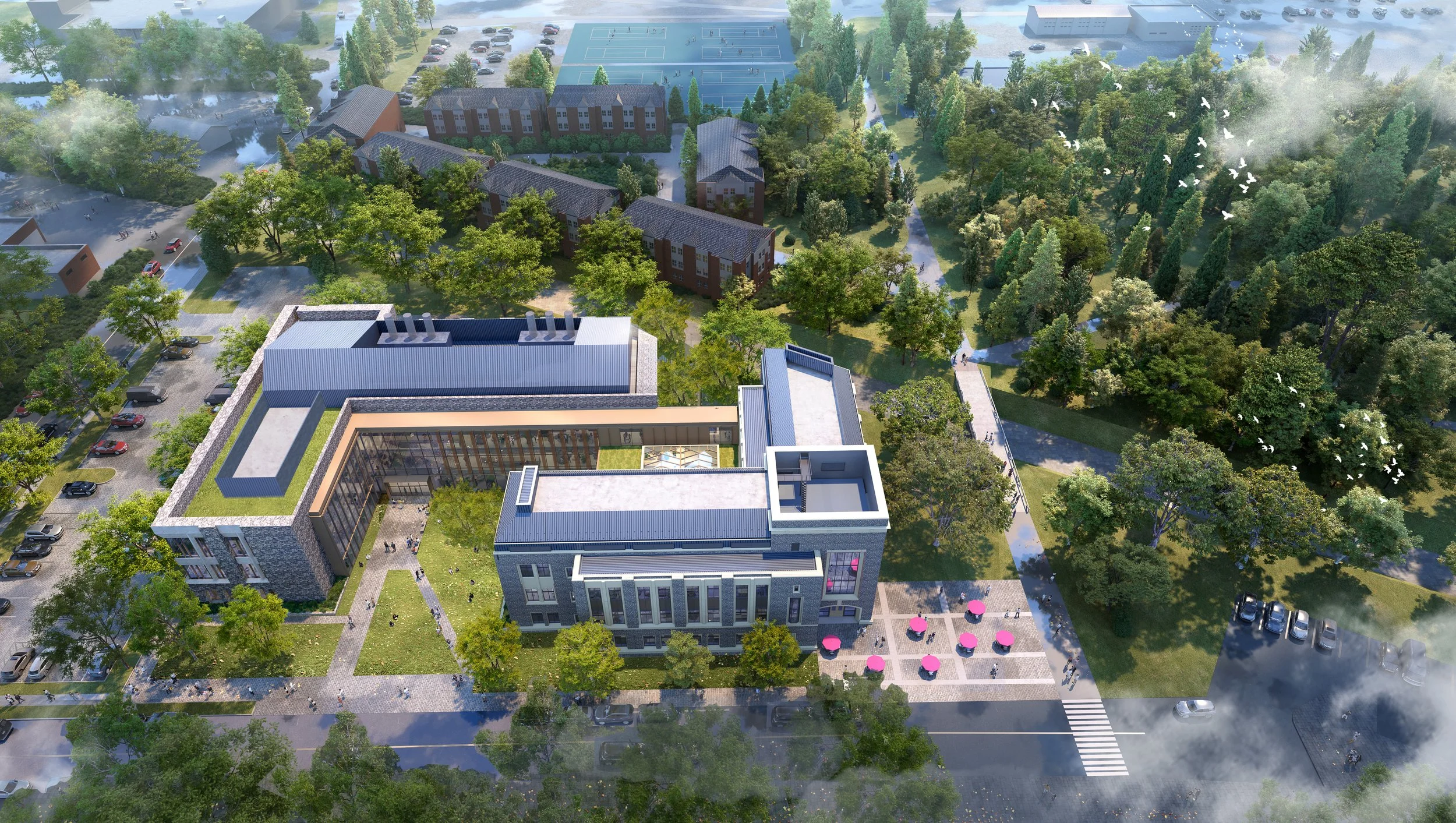
Aerial view of Marist’s future integrated Science and Health complex. The new 100,000-square-foot building (left) connects directly to the existing Allied Health facility (bottom right) and anchors Marist’s $100 million Science and Health Initiative. Renderings courtesy of HGA
Marist University is set to take a large step forward in growing the Science and Health program, beginning with the expansion of the Allied Health building.
The expansion will result in a structure nearly triple the building's current size. The 100,000-square-foot facility will occupy the area of the Beck parking lot that sits behind it.
The $100 million investment is intended to expand the Science and Health program, strengthening Marist as a place for future scientists and healthcare leaders, as demand for science and health-related undergraduate education continues to grow.
“We have really amazing faculty and really great students, but the spaces right now aren't necessarily giving them room to really flourish,” said Associate Professor and Chair of Biology, Megan Dennis. “We've been working in a very collaborative way with the architects and with the upper administration to make sure that we end up with a design that really supports student needs, and it gives us a lot of flexible space to offer new kinds of experiential learning.
Additionally, in the coming years, Marist is looking to implement a Nursing program, which would require state approval, as well as a Physics major.
Though the goal of this initiative is to attract students interested in science and health, Marist President Kevin Weinman emphasized that this is not an enrollment growth strategy.
“A nursing program allows us to think about an incremental increase in the number of students that we bring here, but what we really want to do is just have a much more attractive option for students who are considering a wide range of health and science majors,” he said.
If Marist is granted state approval, the aim is to open the building and bring in the first members of the nursing program in the fall of 2028.
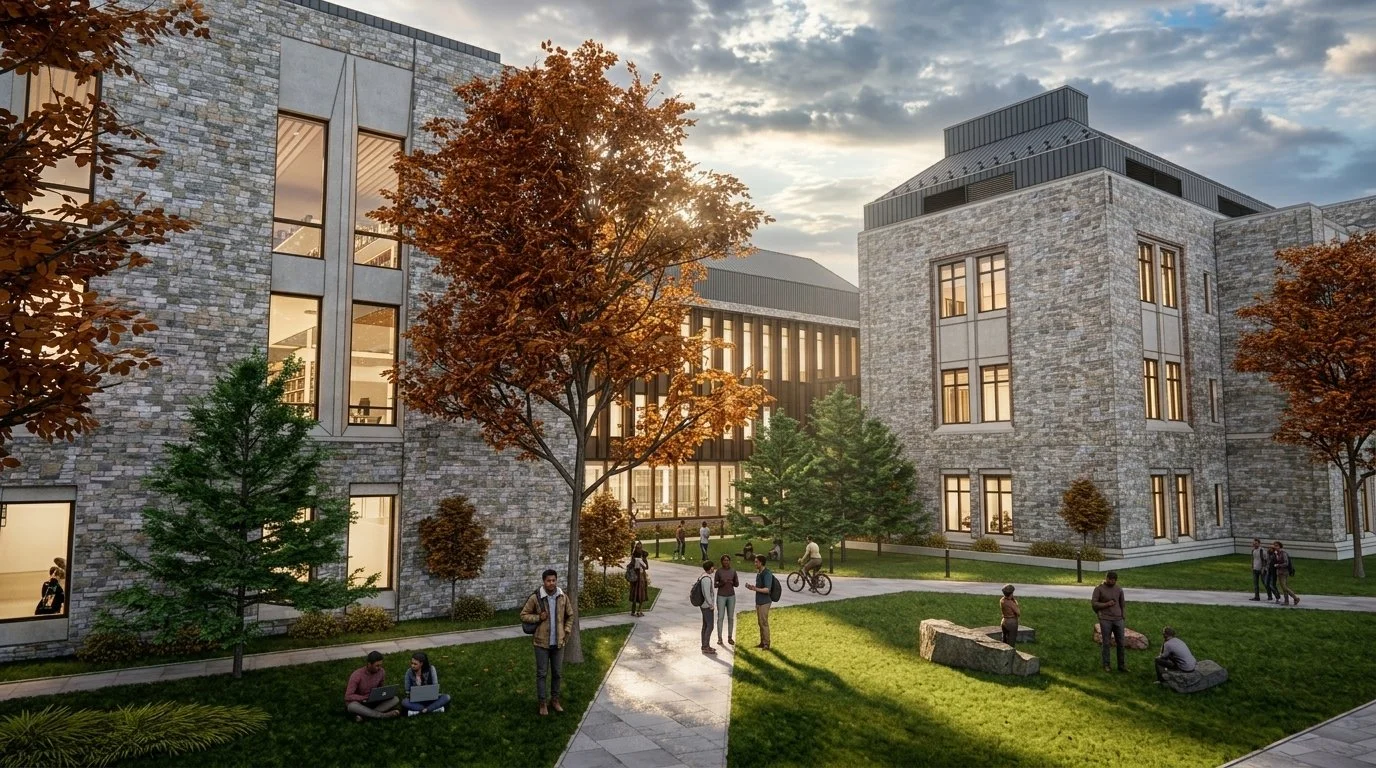
The main entrance and courtyard for the new Science and Health building, facing west towards the Hudson River, offers a welcoming front door and gathering space for the campus community. Renderings courtesy of HGA
There is also hope that the new space will act as a hub for students to socialize. The building will feature a cafe and an atrium to attract and accommodate students, similar to the Dyson Center.
“What we really lack on the East part of campus right now, underneath the tunnel, is some gathering space and another food outlet, and we'll figure out what exactly that will look like over time,” said Weinman. “Giving students who may not even be taking classes in that building a reason to make it theirs.”
The plans for the building began in 2023. Provost Catherine Kodat noted that it was one of her first conversations with Dean of the School of Science, Alicia Slater.
The conversation began with the building that currently houses the science and health students: Donnelly.
“Donnelly was not built for the sciences,” said Weinman. “We've made it work, but it was never built with imagining the very best ways that faculty can teach students and do research.”
“[Donelly] breaks up the community among both the faculty and the students in the School of Science, so we don't see people as much,” Dennis added. “That will be amazing in the new building, and I think lead to a lot of collaborative opportunities.”
However, this building will not replace Donnelly entirely. The new E-Sports lab has given Donnelly youth, and there are also still many administrative offices that have their home there. The issue lies in the safety of the aging facility; Donnelly is not the safest building to occupy an ever-growing, highly technical program.
“To have some of your high-precision academic equipment in there is not ideal,” said Weinman. “So moving some of that sort of high technology, high-risk equipment and functions out of there is first and foremost.’’
Right now, there is a particular method of fume hooding in the labs of Donnelly that operates, but is limited. Therefore, the quality of the ventilation system in the new building is a huge priority.
“We will have students who want to go on to graduate study from our undergraduate science programs, and they will have, by virtue of working in the labs that we have here, they will already be familiar with very up-to-date technology,” said Kodat.
Similarly, the new building will feature modular labs, which are designed to be rearranged easily so they can grow, shrink and adapt as research needs change over time to fit the needs of the program.
“Long, long term, sure, there's a possibility to reimagine what [Donnelly] could look like with a different facility. But that's for the future, nothing to announce there. But this got us one step closer to imagining something different for that space,” said Weinman.
Marist engaged with an architectural firm about six months ago, which has worked on similar projects with other schools. Weinman and the team behind the project visited universities such as MIT, Harvard and Dartmouth to gain inspiration on how this initiative would best fit Marist’s needs.
“The enthusiasm that we've experienced from the board has really been tremendous. As with any significant investment, there are questions and concerns, and how does this fit into the bigger picture? But in general, every time we've talked about this and gotten it a little further along, the board has become more excited about it,” said Weinman.
However, a predicted concern from students would be the occupation of the parking lot.
“In the short term, there's a combination of different places that we can add parking,” said Weinman. “Some, as simple as relining Beck, and being more efficient, and other cars that we can accommodate there. And others will be the expansion of parking nearby. So, we recognize the parking crunch and student sentiment on parking, and even if we were not required to, we would be sure not to have this cost us space.
Weinman also explained the details of the large budget being used for this initiative, which is largely made up of borrowing and the use of accumulated resources over time. Weinman also noted that with the slight growth in enrollment, the initiative will ultimately support itself.
“Now, that will take some time, so we're gonna have to sort of bridge from here to there,” he said. “But the goal here is for this not to be averted on the rest of the budget. That's a strategy that will handle itself.”
Weinman also noted many fundraising opportunities for the alumni community and ensured the five other schools at Marist would not feel a financial burden.
“It's really going to allow us to sort of begin. I mean, last year, it was about a year ago that we made the move from college to a university. And this is of a piece with that, right?
I think this is a huge step forward for our students,” said Weinman. “A huge step forward from Marist.”