AI is Attempting to Kill the Artistry of Music
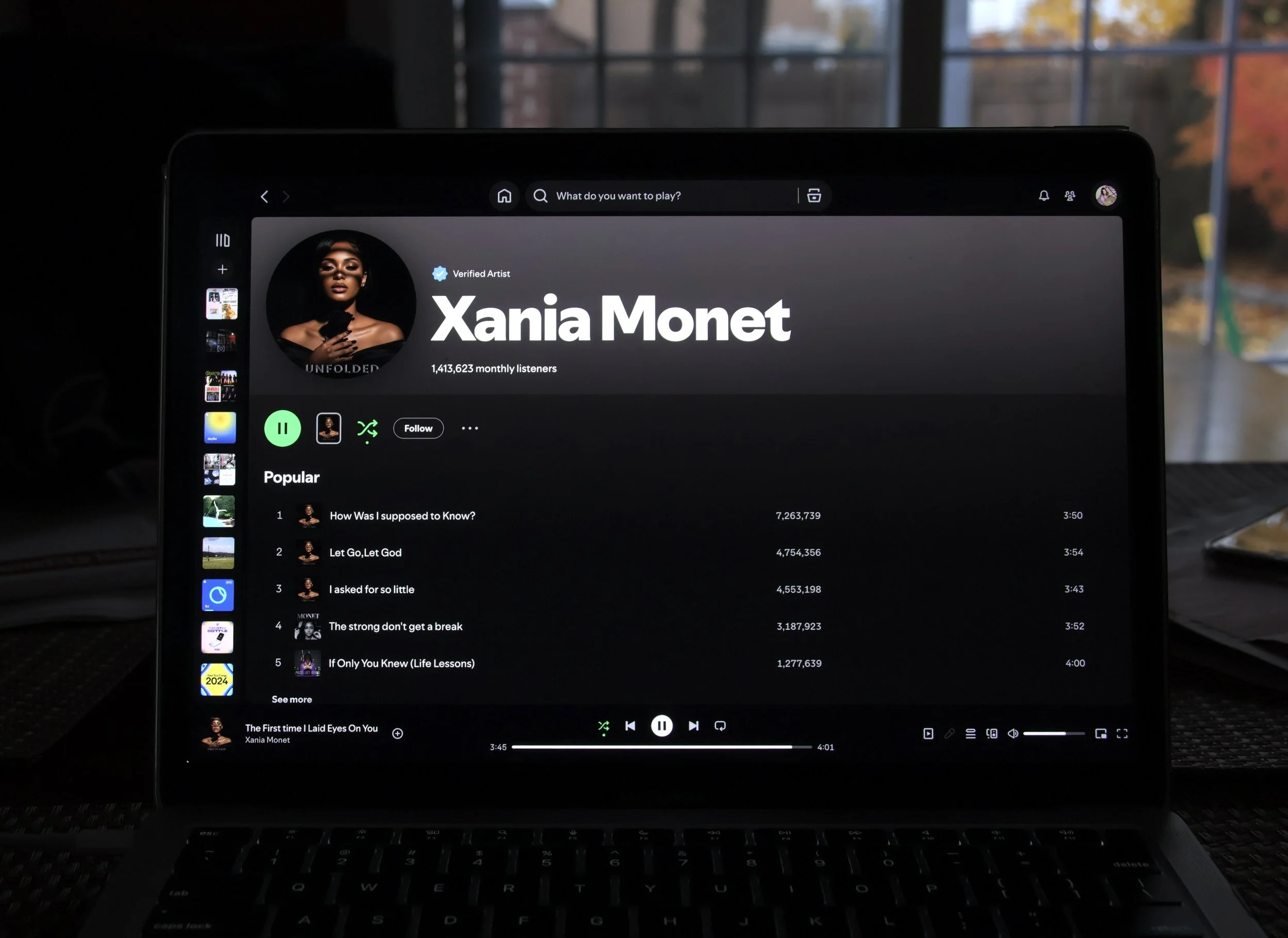
Spotify page of AI music artist Xania Monet where she has roughly 1.4 million montly listeners. Photo courtesy of Ciara Molloy
Upon releasing her debut album, “Unfolded” in August 2025, R&B artist Xania Monet currently has about 1.4 million monthly listeners on Spotify, has appeared on multiple Billboard charts and just signed a multi-million dollar record deal with Hallwood Media.
The catch is, Xania Monet is not real; she is an artificial intelligence creation. But while Xania is AI-generated, her creator, a woman named Telisha “Nikki” Jones, is a human who writes the lyrics to Xania's AI-generated songs.
What is interesting in the case of Xania and her creator is that the lyrical aspect of her music has a human element attributed to it, but the vocal and the instrumental composition do not – something that is critical to someone who’s deemed a “music artist.”
An entity like Xania in the music industry raises a plethora of questions about the future of AI and music. Can AI successfully replace musicians and vocalists? Is there room for AI artists in the industry? Are AI artists and the humans that power them innovative in a sense?
To put it bluntly, no. AI artists, even when puppeteered by a human, do not have the same credibility that a musician has.
However, the fact that Jones plays a role in powering Xania Monet complicates this idea, and it is important to break down her creative process to understand the controversy surrounding Xania Monet.
In a CBS video interview with Gayle King, Jones talks about how Xania’s lyrics come from poems she has written and are 100% written by herself with no use of AI.
In her songs, she touches upon personal experiences, one of them being the loss of her father at eight years old, which she captures in the popular Xania Monet song “How Was I supposed to Know?”
In the interview, Jones demonstrates how she creates Xania Monet songs using Suno, an AI music generator. Jones inputs her own lyrics into the Suno platform, and types in prompts such as “slow tempo,” “deep female soulful vocals,” “heavy drums” and whatever else she may want to produce the sound and style she wants for that song.
Within a matter of seconds, Suno produces a song with all the commands given by Jones, accompanied by her own lyrics, and thus, an Xania Monet song is swiftly created.
While technologically impressive to a certain degree, the whole aspect of musicianship that is integral to composing music is thrown out the window.
Jones, who has no vocal or instrumental talent, gets away with using those abilities that give music artists credibility and uniqueness within the industry.
King pressed Jones in the interview, asking her if she thinks she takes a “shortcut” by using Suno to create songs.
Jones responded, “I wouldn’t call it a shortcut, because I still put in the work. And anytime something new comes about, and it challenges the norm and challenges what we’re used to, you’re going to get strong reactions behind it.”
“I just feel like AI, it’s the new era that we’re in, and I look at it as a tool, as an instrument… utilize it,” added Jones.
Jones makes a fair point, and she isn’t necessarily doing anything “wrong” with using AI to produce music, as it is becoming more acceptable and accessible.
But Jones does take a shortcut. She is not creating guitar riffs, basslines or drum fills. She doesn’t have technical vocal skills and has not spent years of practice dedicating herself to becoming a better singer.
Additionally, a platform like Suno cuts out the need for a producer, getting rid of the musician-producer dynamic that shapes how music is made, evolved and built upon.
It is respectable that Jones uses her own poems as lyrics, so to say she lacks any sort of credibility would be wrong, as she does put effort into her lyricism.
However, using Xania Monet as a vessel for her poems to be platformed and then deeming her a “music artist” simply because the lyrics are set to AI-generated compositions is not valid.
By this logic, anybody who has written a halfway decent poem or song lyrics and has the capability to input them into Suno or some other AI platform can call themselves a “music artist.”
The effort of composing music and the intricacies that go into creating songs and albums are something that does not happen with the interference of AI. It will never produce something bold and distinct as it is only programmed to do certain, calculated things.
Influence within music has always been produced by humans. Jimi Hendrix’s ability to give life to the instrument of the guitar, Aretha Franklin’s soulful vocals and Madonna’s reimagination of pop and provocation are just a few examples of things that could never be created by AI and its inability to tap into the endless possibilities of the human psyche.
It’s quite alarming to see that a craft that has historically relied on human ideas, thoughts, creations and influence could be infiltrated by AI, and that AI artists could reach the same feats that real people have within the music industry, like in Xania Monet’s case.
Powered by a human or not, AI music artists will never have the same innovative leverage that real human music artists have, as the art form has evolved and been kept afloat by those who can produce real, meaningful impact.