Trump’s Fixation on the Kennedy Center
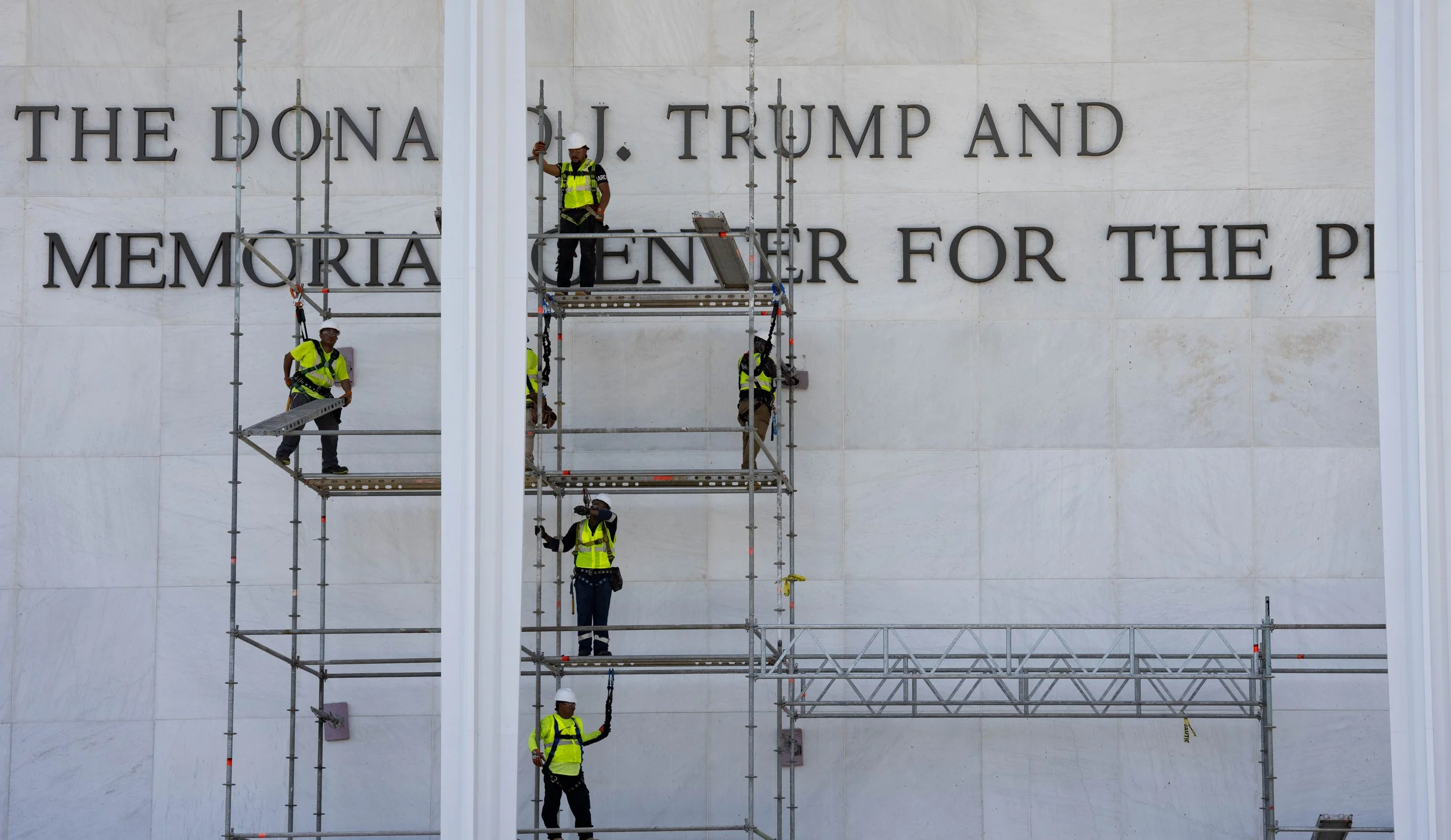
Kennedy Center on the afternoon of June 12th, as they are preparing to take Trump's name down per the court-ordered deadline. Photo by Victoria Pickering on Flickr
President Donald Trump is set on renaming the Kennedy Center, but renaming something he doesn’t agree with isn’t new. In just under two years, he has already targeted bodies of water, mountains, airports and even the general concept of artificial intelligence.
Trump’s takeover of the Kennedy Center began Feb. 7, 2025, when he announced on Truth Social that he would be removing members of the board of trustees. He replaced these members with underqualified allies who then appointed him as chairman.
Trump’s name appeared on the building just one day after the board voted to change the center’s name to “Trump-Kennedy Center.” This change didn’t come without pushback from Congress, the public and even members of the Kennedy family.
“Like a child who can’t play with a toy, he wants to stomp on the toy. But this is not a toy,” said Kerry Kennedy, a niece of the late President Kennedy. “This is the living memorial to a slain president.”
Following a ruling by a district judge, the Kennedy Center was forced to remove Trump’s name from the building. The judge argued that because the center and its name were both established by law, only Congress had the power to change its name. It was also ruled that the board could not attempt to put Trump’s name back up without Congress’ blessing.
The law governing the center states that “no additional memorials or plaques in the nature of memorials shall be designated or installed in the public areas of the John F. Kennedy Center for the Performing Arts.”
In addition to the name change, the board also tried to close the center for two years, proposing $257 million in renovations and citing physical conditions and plummeting finances in its decision to temporarily close. This decision was also blocked by a judge.
Beyond physical damage, the center was already suffering. In light of political tensions, many performers chose to cancel their events or perform elsewhere.
The John F. Kennedy Center for the Performing Arts, originally the National Cultural Center, was established by law in 1958 by President Dwight D. Eisenhower. Following President Kennedy’s assassination, Congress passed a joint resolution that gave the center its current name, established it as a living memorial and authorized funding for its completion. Today, it is home to various kinds of arts and events, including dance, musical theater, opera and classical music.
In an attempt to get around this ruling, the board voted to instead inscribe the president’s name underneath the official name. This inscription would read: “Restored and Renovated by President Donald J. Trump.”
“For the Trump administration, for me, to get involved, and to take on long term, and to carry it, or to raise money to carry it, I think that the Trump administration should certainly have recognition,” the president said to a CNN reporter. “Because frankly, if we don't do that, it's going to close, it will end up being ripped down.”
In Trump’s mind, if he doesn’t get the recognition he feels he deserves, there’s no point in continuing improvements on the center. If he cannot get his name on the Kennedy Center, then it should not exist.
As of Sept. 15, the Kennedy Center was temporarily closed for a safety assessment, while a proposed two-year renovation remained contested. The decision from the board came mere hours after a ruling again blocked the president from having his name on the building.
The president justified this decision by citing the building's “virtual state of collapse” after a storm caused a piece of the grand foyer’s ceiling to crumble. Though no injuries were reported, he claimed that a security guard was “60 seconds away from certain death.”
A judge swiftly ordered that the administration must give at least 30 days’ notice before moving to demolish any part of the center.
Just days later, thousands of people participated in “Hands Around the Kennedy Center,” a protest organized by Hands Off the Arts to voice opposition to the destruction of the building. At one point, the protesters even formed a human chain around the building.
Chris Raleigh, co-founder of Hands Off the Arts, said in an interview that he hoped the event would show that the people are willing to fight to prevent the destruction of the building.
However, the Kennedy Center is just one of the many ways he’s attempted to hurt the arts.
Since the beginning of his second term, he has actively limited federal funding for the National Endowment for the Arts (NEA), the National Endowment for the Humanities (NEH) and the Institute of Museum and Library Services (IMLS). He has also fired members of these boards and pulled grants that fund institutions including local theaters and museums.
Additionally, Trump has made it a focus to criticize the Smithsonian Institution. Even though the Smithsonian is an independent institution, the president is still seeking to change which aspects of history the Smithsonian can discuss and how it is allowed to discuss them.
The president’s executive order criticized the Smithsonian’s presentation of American history. He also described the Smithsonian as “OUT OF CONTROL.”
“Where everything discussed is how horrible our Country is, how bad Slavery was, and how unaccomplished the downtrodden have been — Nothing about Success, nothing about Brightness, nothing about the Future,” Trump said.
With October being National Arts and Humanities Month, we should remember that the arts were never meant to be neutral. Art has always been political, and any attack on the arts is a threat to the voice of the people. This is more than a disagreement over a name; it is about an administration that refuses to take no for an answer.