Entertainment Over Players’ Health
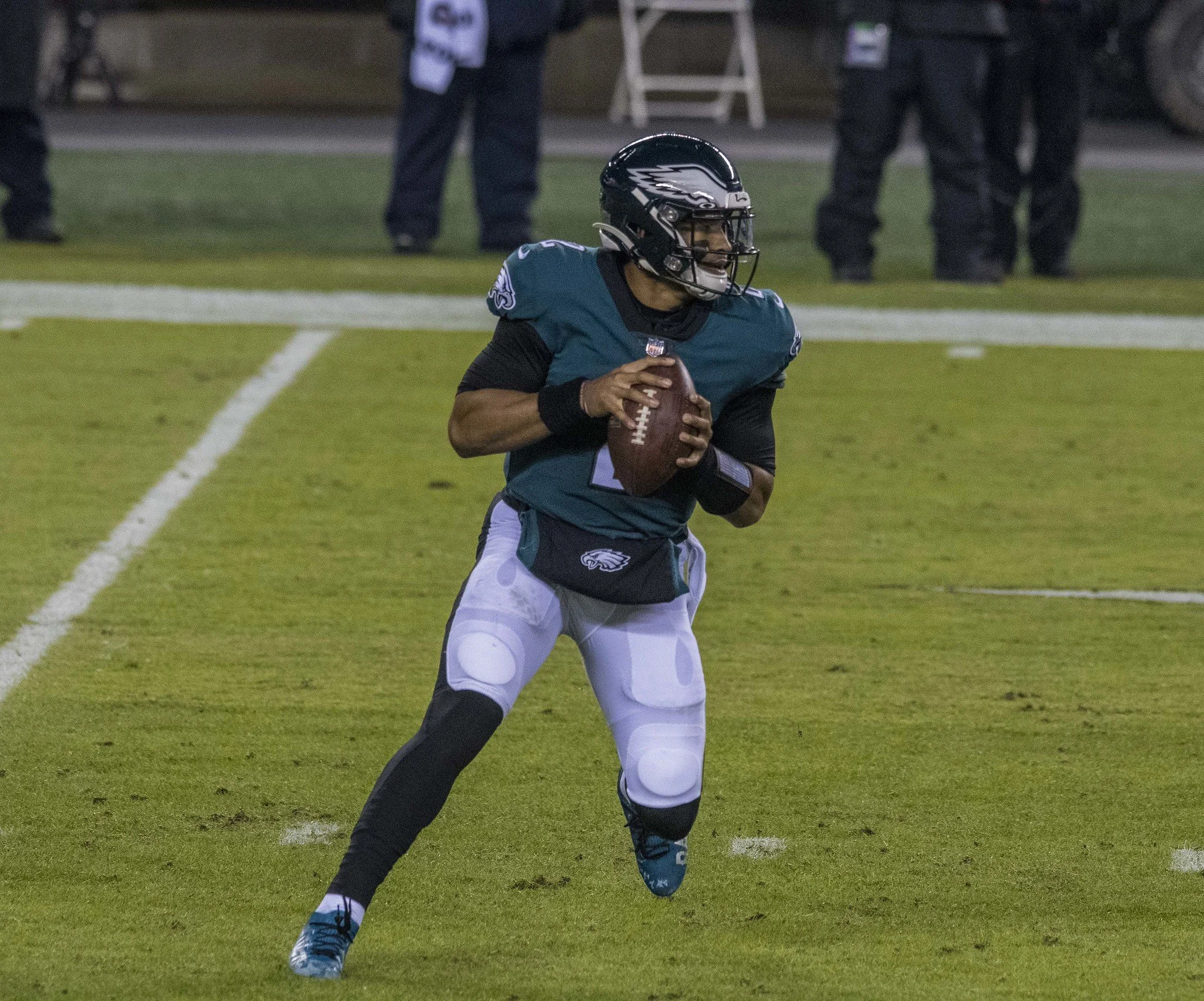
Jalen Hurts in action in 2021. Photo by All-Pro Reels via Flickr
In a breaking report by ESPN, it was revealed on Monday, Oct. 19 that well-known NFL quarterback Jalen Hurts suffered a season-ending injury following the Philadelphia Eagles’ game against the Jacksonville Jaguars on Oct. 11. After being examined on Oct. 17 and 18, doctors found that Hurts had multiple instances of a pulmonary embolism, with blood clots present in his lungs – a grave threat to his life without direct treatment.
The worsening of this injury comes from a prior instance where examiners found blood clots located in Hurts’ calf, discovered before Hurts played in the Oct. 11 game in London. The cause of Hurts’ blood clot formation is believed to have been from getting struck in his calf by a cleat during the Eagles’ game against the Rams on Oct. 4.
In order to treat the blood clots in Hurts’ calf, doctors concluded that mobility was essential which made him eligible to play in the game. Despite rumors circulating that Hurts did not sleep for 36 hours, the quarterback was able to sleep in the morning prior to the London game.
However, Hurts was given the all clear by medical professionals to fly on a plane back to the United States. Dr. Jordan K. Schaefer, associate professor of internal medicine at the University of Michigan, offers insight on this decision.
The interviewer asked Dr. Schaefer a question regarding whether flying can either create a blood clot or worsen it, to which the doctor responded that long-distance travel is a known risk factor for blood clots. Furthermore, the Centers for Disease Control and Prevention states that anyone travelling for more than four hours via an airplane, a car or a bus can be at risk for blood clots.
If medical professionals and the national public health agency of the United States all acknowledge flying as an aggravating factor that can result in a pulmonary embolism, we’re left questioning why Philadelphia Eagles’ medical staff decided to let Hurts on the plane in the first place?
Allowing the quarterback to fly despite concerns about blood clots raises questions about whether the NFL values entertainment over its players’ well-being.
This decision raises questions about the Philadelphia Eagles medical staff and points to a much deeper conflict in professional sports. The NFL and NFL Players Association are jointly reviewing how Hurts’ diagnosis was handled, while league officials maintain that medical protocols were followed.
From clearing a player for a flight of more than four hours despite potential health risks to sending players back onto the field after head trauma, there is a division of loyalty amongst medical staff. Said conflict derives from the organizations – who pay the medical staff – focus on immediate athletic performance rather than post-career health.
The broader concern about player safety also extends to long-term neurological issues such as chronic traumatic encephalopathy (CTE). As defined by the Concussion & CTE Foundation, CTE is a “degenerative brain disease linked to repeated traumatic brain injuries, including concussions and nonconcussive impacts.” It is found primarily in athletes and military service members who endure repetitive brain trauma.
According to researchers at Boston University, Mass General Brigham and the Concussion & CTE Foundation, an estimated 75% of retired NFL players who died between 2008 and 2023 had CTE, which is only diagnosable after death. Furthermore, retired wide receiver Antonio Brown claims that he has significant memory loss of his football career caused by CTE.
This astonishing statistic raises further questions about the NFL’s emphasis on long-term wellness versus momentary competitive advantage – a reality showcased through the post-career struggles of players like Antonio Brown.
Whether questioning the decision to allow Jalen Hurts to fly with a blood clot or the harmful effects of recurring hits to the head, the common factor is a culture within the NFL that prioritizes entertainment at the expense of its players’ lives.