How 2026 Winter Olympic Uniforms are Weaving Politics, Identity and Climate Action into Fabric
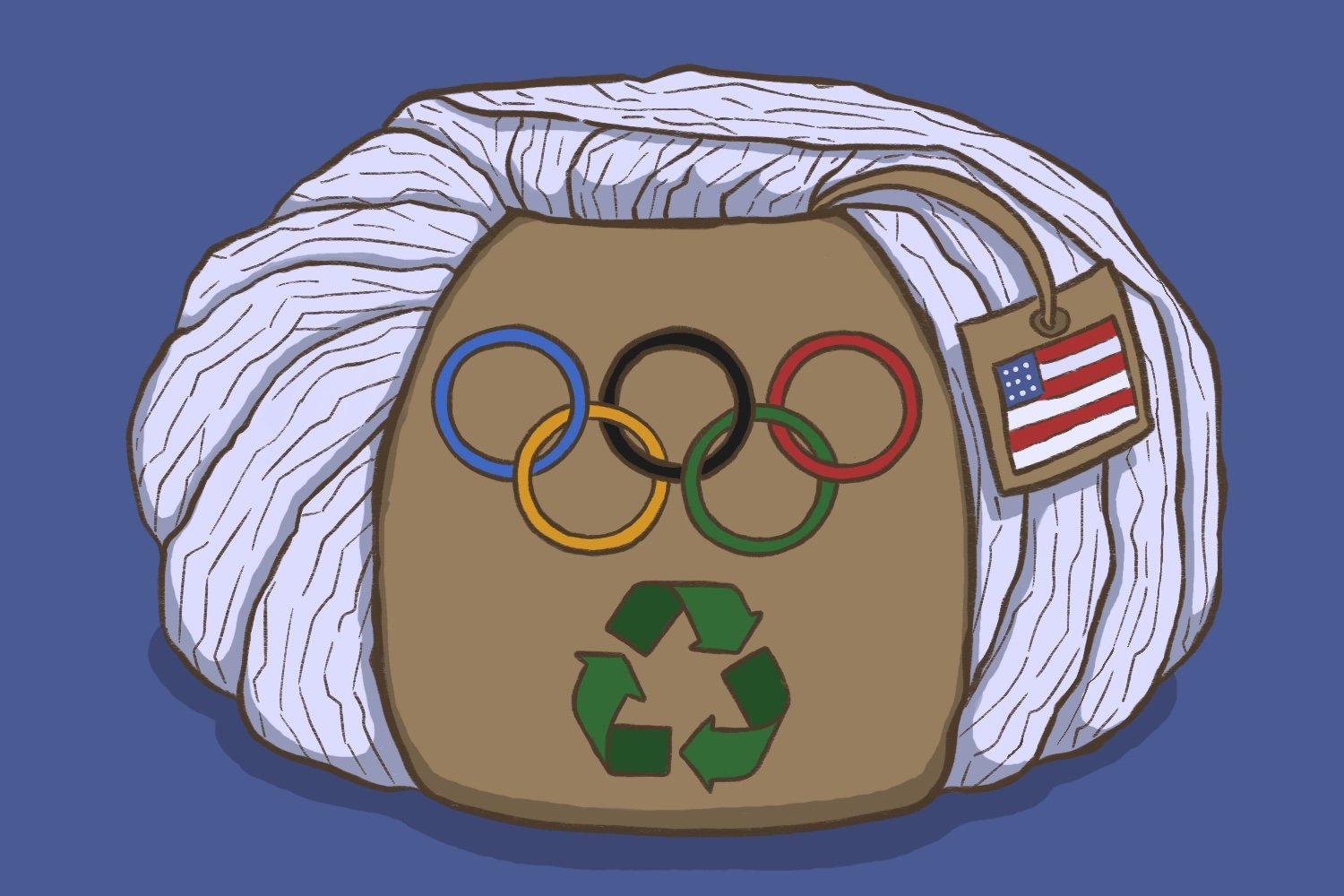
Certain countries and athletes have been using their fashion to promote political and symbolic messages. Illustration by Sarah Brennan '28
The 2026 Winter Olympics in Milano-Cortina have reimagined the traditional Parade of Nations as a platform for environmental and social expression. Although the International Olympic Committee (IOC) enforces Rule 50, which bans overt political demonstrations on the field of play, many national teams are finding subtle ways to share their values and cultural identities.
For many nations, official Olympic uniforms have become one of the most visible ways to express positions on global issues without risking formal penalties.
Considering that context, fashion is inherently political because it shapes how a country presents itself to the international community. Every design decision, from where the fabric is sourced to the cut and structure of a jacket, can serve as a quiet statement about a nation’s values, priorities and influence.
Haiti’s presence in Milano-Cortina has marked a historic moment, as its uniforms were the only hand-painted kits at the Games, crafted by Italian-Haitian designer Stella Jean and inspired by Haitian artist Édouard Duval-Carrié. These designs featured a red, riderless horse against a vivid backdrop, symbolizing Haiti’s resilience and cultural heritage.
“Haiti’s presence at the Winter Olympics is a symbol, and a statement, not a coincidence,” said Haiti’s ambassador, Italy Gandy Thomas, to the Associated Press. “We may not be a winter country, but we are a nation that refuses to be confined by expectation… Absence is the most dangerous form of erasing.”
Originally, Jean’s designs included an image of the Haitian revolutionary leader Toussaint Louverture, but the IOC required it to be removed under Rule 50. Even with that restriction, the final uniforms still make a strong cultural statement.
The United States delegation entered the Milano-Cortina opening ceremony wearing uniforms designed by Ralph Lauren. The outfits included winter white wool coats, knit sweaters with the U.S. flag and Olympic rings and tailored pants.
The use of classic fabrics and the red, white and blue palette reflected long-term design traditions seen in previous Olympic Games. In recent years, Ralph Lauren has incorporated recycled materials and improved production transparency, both of which were included in the 2026 Olympic uniforms.
These elements highlight efforts to include more sustainable textiles in official apparel. The inclusion of recognizable national symbols and a consistent brand partnership provides continuity with past Olympics.
Mongolia’s uniforms at the 2026 Winter Olympics stood out for combining traditional design with modern performance. Designed by Goyol Cashmere, the outfits combine function with nomadic heritage.
The silhouettes were inspired by the deel, a long, belted garment worn in Mongolia for generations. For the Olympics, the design was updated with “clean lines, silk trim and subtle horn-inspired details,” according to a post via Bantr on Instagram.
Fabric selection was especially significant. Mongolia is one of the world’s leading producers of premium cashmere, a material that has long been essential for surviving extreme cold. By using domestically sourced cashmere, Mongolia’s Olympic uniforms reflected both a key part of the national economy and the realities of the climate.
Rather than depending on oversized logos or trends, Mongolia’s design communicated identity through intentional structure and fabrics. In a ceremony where many outfits can blend, the uniforms stood out for their focus on heritage and environment while still staying within Olympic guidelines.
During the Parade of Nations, the uniforms are the first thing the world sees. They mix culture, national pride and thoughtful design to show how each country wants to represent itself on a global stage.
As the ceremony concludes and the focus shifts to the field of play, these designs remain a permanent and intentional part of the Games’ historical record.