The Protest Song: Lost Art, or Powerful Comeback?
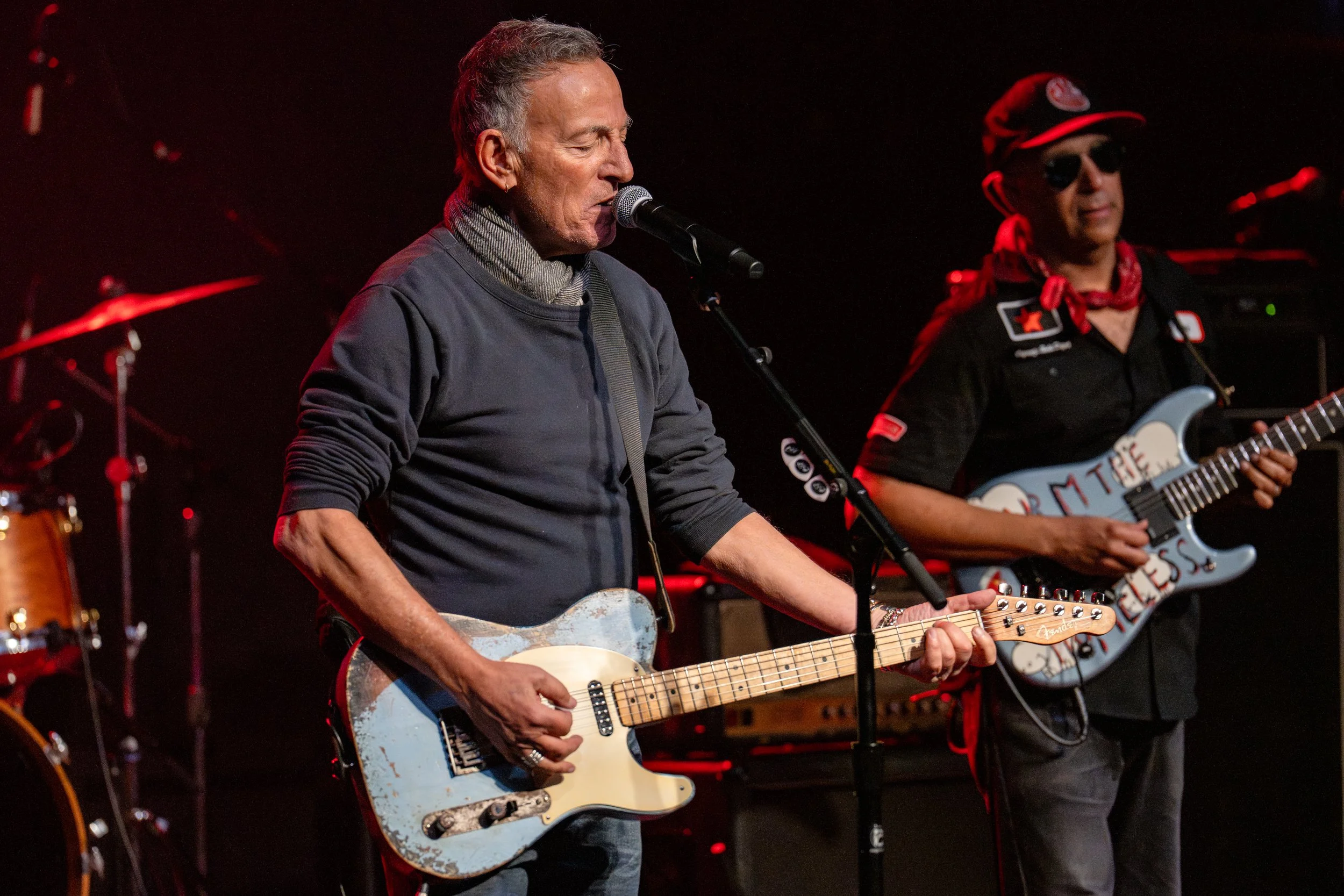
The protest song has long been a vehicle of change, emotion and power, as well as a reaction to widespread indignation and demand for more. Although it is most strongly associated with the Civil Rights Movement and anti-war protests of the 1960s and 1970s, the art of the protest song is neither unique nor limited to this period.
Protest songs have rallied Americans throughout history, from the Revolutionary War to the suffrage movement and abolition, along with the notable era of Civil Rights and anti-Vietnam War movements.
The musical inspiration that drives this style of song comes from times of great conflict and subsequent passion. But if that is the case, the current state of the country should create a situation like that of the 60s, a period defined by its music. So, where are our protest songs?
When left with the term “protest song,” music enthusiast Samantha Stulbaum ‘26 says she immediately thinks of Vietnam. “I think of Creedence Clearwater Revival, and ‘Leaving on a Jet Plane’ by John Denver. It is my music taste, but I immediately go to the 60s.”
“Some would argue that The Beatles’ ‘All You Need is Love’ is a protest song, and as a Beatles fan, that might have to be my top,” Stulbaum added. She noted that for this song, the Beatles were asked to write a song to unify, which is a protest in and of itself, but somewhat different from other protest songs of its time.
One can’t discuss protest songs without Bruce Springsteen’s “Born in the U.S.A.” Typically, the soundtrack to summer nights and Fourth of July fireworks, the song about a Vietnam veteran returning home is often misunderstood.
Stulbaum noted that “Springsteen is the most ‘American’ man. A blue-collar, hard-working, pulling you up from the bootstraps kind of guy, but then you look at “Born in the USA.” It is a song loved by Americans, but if you look at the lyrics, it is an anti-government, anti-Vietnam War song.”
Springsteen recently released another protest song, “Streets of Minneapolis.” Similarly, like “Born in the U.S.A.,” the song is a direct response to President Donald Trump’s deployment of ICE, mass deportation, and the killing of Alex Pretti and Renée Good in Minneapolis.
Released on Jan. 28, just days after Pretti’s murder, the song is timely, powerful and specific in its stance. Because of its quick production, Stulbaum stated, “It isn’t the most acclaimed musically, but it is such an important message that I don’t think that it really matters. I was just sitting there listening to it, and it is so comparable to ‘Ohio.’”
The “Ohio” that Stulbaum references is the work of Crosby, Stills, Nash & Young, recorded in 1970, just days after the Kent State shooting, where four students were killed by the Ohio National Guard during an anti-war protest.
“Streets of Minneapolis” strongly mirrors “Ohio” through its direct word choice. Where Crosby, Stills, Nash & Young sing “Tin soldiers and Nixon coming / We’re finally on our own / This summer I hear the drumming / Four dead in Ohio,” Springsteen sings “Where mercy should have stood / And two dead, left to die on snow-filled streets / Alex Pretti and Renée Good.”
Both emphasize civilian deaths and also address the presidential administrations involved. Former President Richard Nixon is namedropped in “Ohio,” and a reference to “King Trump’s private army” is featured in “Streets of Minneapolis.”
Stulbaum recalls hearing “Streets of Minneapolis” for the first time: “I was thinking, ‘Oh my God, I’ve always wanted to go back to the 60s.’ I am very sad that it is happening again, and it’s very concerning on a global scale, but there is a little part of me that is like ‘Wow, I’m seeing this first-hand.’”
“I think we’re in a place where people feel the need to speak out. The world is in such a chaotic state that there have been a lot of comparisons to the 60s,” said Stulbaum.
However, she thinks the music industry is in a much different position than it was almost 70 years ago. She attributes this to the ability for artists to use social media as their platform, rather than their music alone.
Gone may be the days of wide-spread and well-known protest songs such as The Animals’ “We Gotta Get Out of This Place,” Black Sabbath’s “War Pigs,” Creedence Clearwater Revival's “Fortunate Son,” Bob Dylan’s “Blowin’ in the Wind” and “The Times, They Are a-Changin,” and the reign of Woody Guthrie and Phil Ochs, but powerful songs are still out there.
“There are so many smaller artists that I think are trying to do this that haven’t made it yet,” said Stulbaum. She noted a band called Fantastic Cat and their song, “C’mon Armageddon," which speaks of the frustrated pessimism of modern political society.
Stulbaum says the artists, meanings and protests are there: “I think we just need to look a little bit harder and give them a little more light.”
Modern protest songs often have their meanings overlooked due to their life in mainstream media, like Springsteen’s “Born in the U.S.A.,” but they are everywhere. Green Day’s 2004 hit “American Idiot” rejects a media-driven society and has been used to push for voter registration. Rage Against the Machine’s “Killing in the Name” addresses abuses of power and is a reaction to police brutality in Los Angeles in 1991.
“Killing in the Name” was also repurposed for the Black Lives Matter movement, which incited many other songs like Lil Baby’s “The Bigger Picture” and Kendrick Lamar’s “Alright.”
“I think there is the potential now to have what we had in the 60s,” said Stulbaum. “It’s definitely there, and I think there are people doing it.”
Although the appearance of the modern-day protest song may look different than its historically folky roots, they are there and will keep coming. They exist right below our noses, meanings often quieted by mainstream media.