The Global Implications of Venezuelan President Maduro’s Arrest
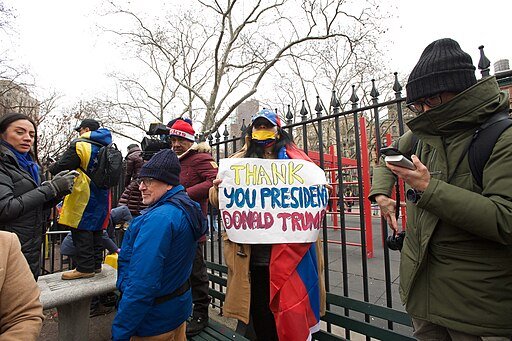
A crowd of people and press gather outside the United States District Court in Manhattan for Nicolás Maduro's arraignment. Photo courtesy of SWinxy via Wiki Commons
In the midst of ongoing global conflicts and rising national unrest, President Donald Trump’s administration moved quickly to carry out “Operation Absolute Resolve,” which ended in the arrest of Venezuela’s President Nicolás Maduro and the First Lady on Jan. 3. The global response, from citizens and leaders alike, has been a mix of praise and disapproval.
Additionally, there have been a wide array of terms used to describe the event, including arrest, abduction, kidnapping and intervention, further displaying its divisiveness on a national and international level.
According to BBC News, the former president and his wife were “indicted on drug-trafficking charges [or narcoterrorism] in New York,” which was unsealed on March 26, 2020.
In a press conference following the intervention, Trump said, “The men and women of our military, working with the U.S. law enforcement, successfully captured Maduro in the dead of night…We are going to run the country…until we can do a safe, proper and judicious transition.”
Among many Venezuelans, Maduro was seen as a dictator. He has been suspected of rigging elections and has openly rejected and mocked his opposition, leading the global community to criticize him for creating an electoral authoritarian regime in the nation. In January, he was sworn in for his third six-year term, despite evidence that he had likely lost the election. At various instances, Trump has also voiced his opinion, siding with the Venezuelan people and calling for their safety to be prioritized.
According to formal international law, the seizure of the Venezuelan executive was unlawful as the United States cannot legally arrest an individual in foreign territory on domestic charges without the foreign entity’s consent, which, in this case, was not given.
In an interview with The Conversation, Mary Ellen O’Connell of the University of Notre Dame noted, “I consider what happened on Jan. 3 as part of a series of unlawful actions by the U.S. toward Venezuela that began on Sept. 2, 2025, when the U.S. first attacked and blew up a small boat in the Caribbean."
Furthermore, she explained that “international law says someone who’s trying to run a government needs to be free of interference by foreign national courts.” With this reasoning, the U.S. military’s actions in Venezuela can be deemed unlawful. However, there lies a greater level of complexity in this issue.
Trump claimed his reasoning for Maduro’s arrest was in an effort to protect American national security and to stop the movement of drugs promoted by Maduro. He has shown interest in bringing about regime change in Venezuela and a desire to reclaim the oil industry while running the country for the time being.
An expert at the Council on Foreign Relations posted that Panamanian President Manuel Noriega’s arrest under the Bush administration serves as a precedent to Maduro’s arrest in that both actions overlooked international laws restricting states from carrying out arrests on foreign territory. This implies a trend in U.S. behavior towards foreign nations.
Some leaders, including Israel’s Prime Minister Benjamin Netanyahu, applauded the arrest, while others, including Russia and China, condemned the U.S. for acting aggressively and infringing on the sovereignty of the country.
Following Maduro’s arrest and the preceding U.S. strikes in Venezuela, the global community raised concerns about the rules of international law not being respected and the “dangerous precedent” that these events have set. In conjunction with Russia’s ongoing invasion of Ukraine and the war in Gaza, along with countless other conflicts, many worry that the U.S.’s action may be used to excuse state behavior that is aggressive and irrespective of international order.
On the contrary, others argue that U.S. operations have only served to promote democracy and freedom. Some claim that the capture of Maduro and his wife marked the beginning of a new era in Venezuela, where the government will represent and serve the needs of the people, as opposed to the previously destructive regime.
Venezuelans worldwide have had equally polarizing reactions. In Spain, a large community of Venezuelans, who previously left the regime, took to rejoicing in the streets upon hearing the news of Maduro’s arrest. They expressed utter joy and relief. On the other hand, others expressed discomfort and fear at what the future might hold for their families in Venezuela, who may face instability in the coming months due to the President’s arrest and the U.S. takeover.
The reactions to U.S. interventions in Venezuela prove to be complex and nuanced, portraying a deep issue pertaining to international law, national security and sovereignty. Moving forward, it is important to continue to monitor.
Many fear the precedent that the Trump administration will set for relations between the United States and other countries. The current administration’s unexpected actions now prompt other nations to reassess whether they can count on the United States, a nation that has been proven dependable for several decades.