Poughkeepsie sees a Flood of Flock Cameras
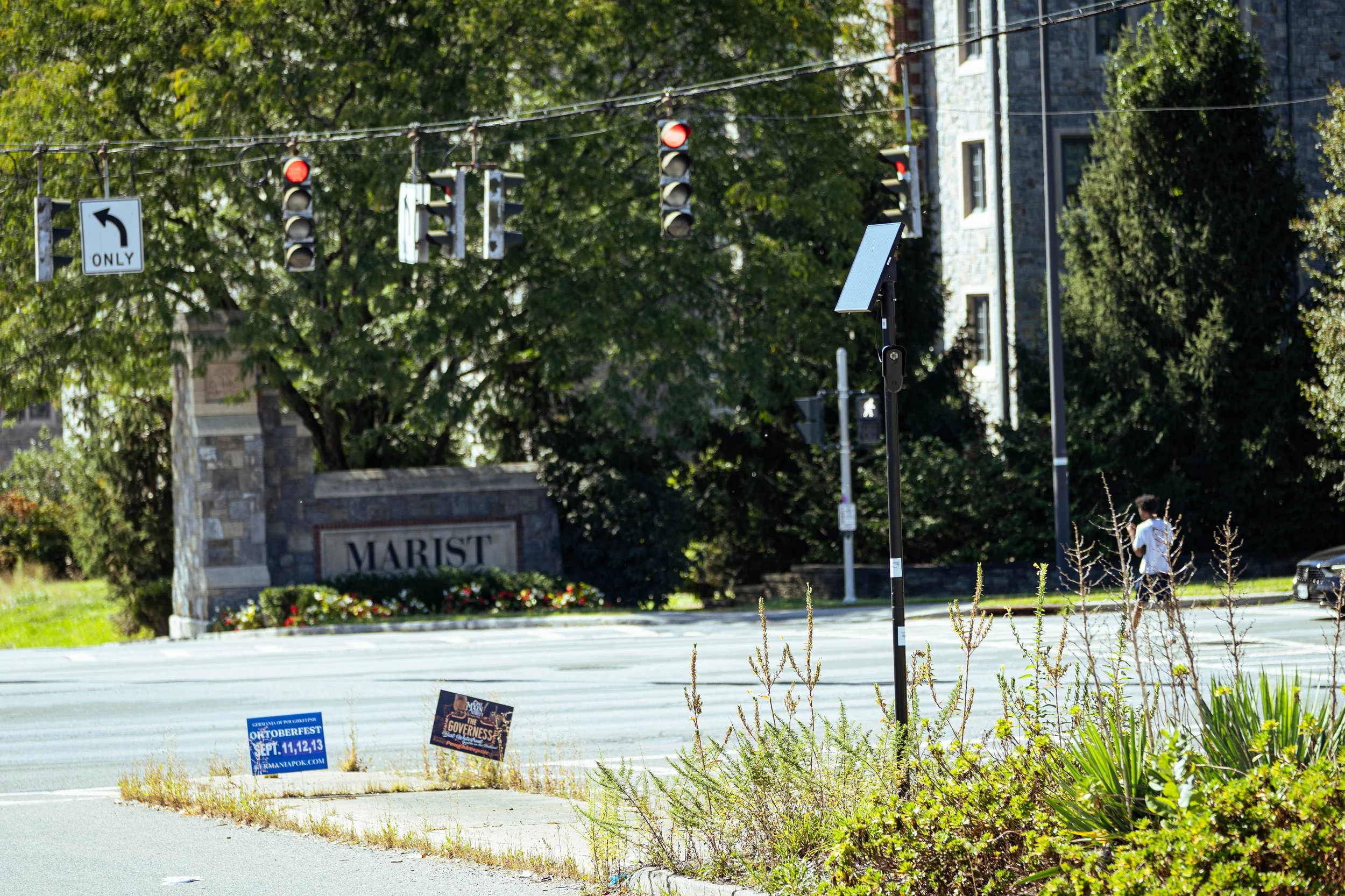
1 of 3 Flock Cameras located in the Hudson Heritage Plaza. Photo by Michael O'Neil '30
There are approximately 31 documented Flock cameras located in Poughkeepsie, including multiple across the street from Marist University, and approximately 64 located in Dutchess County as a whole. The Hudson Valley is not the only area experiencing this upward tick, as many places around the country have been implementing these devices en masse, leaving many people to wonder: What are these cameras for?
The types of cameras that are currently in Poughkeepsie are automatic license plate readers (ALPRs) made by the safety company Flock. These cameras take still images and capture key information about the cars that pass them. This information includes things like license plate numbers, the color of a car, its size, its make/model and unique features such as dents and/or stickers.
Due to their rapid artificial intelligence processing, they do not discriminate what cars they capture data on and even though they are not predictive in nature, they are always collecting information that could be used to track you. However, these cameras are not designed to capture any information about people, whether they’re walking or driving.
The data collected is then all processed locally and put into repositories where AI agents analyze it and link it to the information picked up by other cameras. The people who have access to the system can then query the AI and find specific vehicles.
Even though the data picked up by ALPRs is not tracking people, they still gather sensitive information. For example, if a person drives to the hospital every morning, the ALPR will be able to track their car and know where they are at that given time.
“They [Flock and its users] should design and follow strict protocols to use the technology for the intended goal and no other,” Dr. Gissella Bejarano, assistant professor of computer science, said. “Besides, there should be transparency in the accuracy of these tools to know how to proceed when the match or recognition is not 100% confident of the result.”
Most of the cameras are for police departments and even though the data is secured through multifactor authentication, surveillance of who is accessing the footage and the occasional audit, it is still very possible for these central points where the data is stored to be hacked. Additionally, in other areas of the country, some police officers have been arrested for misusing the Flock data such as searching for ex-partners.
There is also nothing in the contract that police have with Flock that prevents them from choosing to share the data they receive. They may decide to share with other law enforcement agencies in their state or even on the federal level.
Dr. Juan Arias, senior professional lecturer of computing, put it in simple terms.
“There are effectively two layers of control: Flock operates the platform, but the customer agency controls its data and access policies,” he said.
Due to this, there have been many concerns about Flock cameras and their use by U.S. Immigration and Customs Enforcement (ICE). Although Flock itself has no contract with ICE, local police agencies can choose to share data with any federal agency they desire.
Presently, there is no cap in New York State on the retention period in which this data can be accessed, with it typically being stored for a period of around 30 days. Recently however, Flock itself has begun to recommend a retention period of seven days instead, making it so the data collected on the various vehicles would get scrubbed after the week is up.
There is also the matter of the third-party cloud that stores the data. Flock primarily partners with Amazon Web Services (AWS). This can prove problematic as the more independent agencies that access this data, the less secure it becomes.
Flock is not the only company to make ALPRs and eventually we may see a rise in other brands partnering with law enforcement. Flock itself has other types of cameras that we could see the implementation of in the coming years, such as using video and audio to track gunfire.
“I would ask not only, ‘How many cameras does Poughkeepsie have?’ but also, ‘Which other agencies can search Poughkeepsie’s records? Which other agencies’ records can Poughkeepsie search? What justification is required for a search, and who regularly audits those searches?’” Arias said.
This technology and its implementation are in a highly developmental stage; however, it is incredibly important to stay informed about Flock cameras as they begin to show up all over America.
“Technology is a reflection of human values,” Bejarano said. “We need to keep accountability on humans and companies.”