"Feminist Furies": Resistance through Storytelling in a "Patriarchy on Steroids"
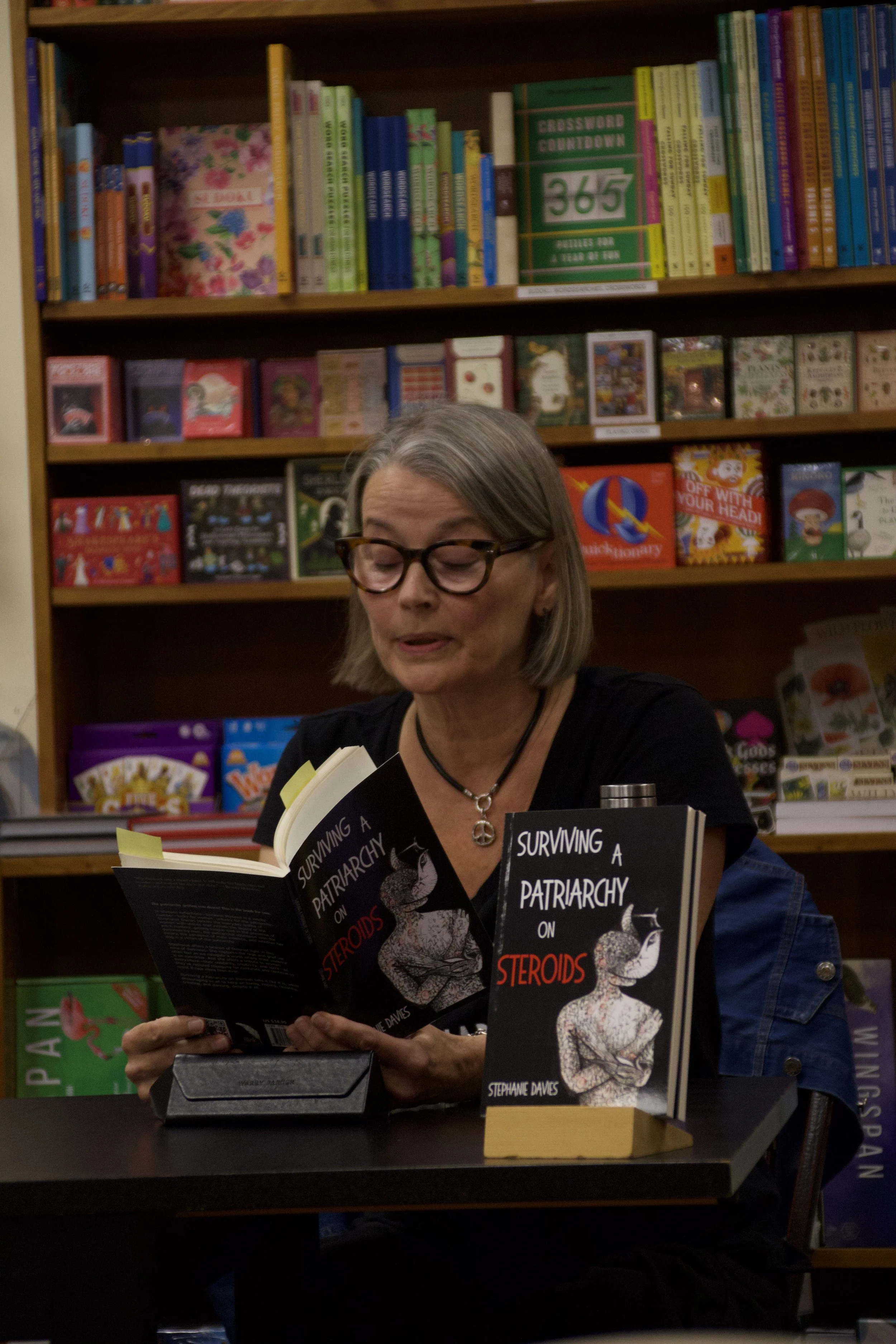
Author Stephanie Davies reading from her book “Surviving a Patriarchy on Steroids” at Oblong Books in Rhinebeck.
On the crisp first evening of fall, readers filed into the warmth of Oblong Books in Rhinebeck, New York, seeking the solace of storytelling and the wisdom of three feminist writers.
Author Stephanie Davies first proposed the event “Feminist Furies” to Oblong following the release of her second book, “Surviving a Patriarchy on Steroids.”
“I contacted local bookstores to see if they'd like to host a reading. I proposed the title, ‘Feminist Furies,’ and I said I wanted two or three other feminist writers with me, if they were interested, so we'd be like the three furies,” Davies said.
The goal, Davies said, was to unite and embolden listeners through stories.
“I hope it inspires some people, especially in these times of misogyny where women are silenced or marginalized, or just objectified, to hear from three strong women who have got our own voices, perspectives, views and stories to share,” she said.
The two women alongside Davies were Beverly Donofrio, a memoirist, essayist and writing workshop teacher who recently completed her fourth memoir, “It Started with Adam, and Ended with a Little Help from Psychedelics,” and Linda Villarosa, contributing writer at “New York Times Magazine” and journalism professor at City University of New York. Villarosa’s book, “Under the Skin: The Hidden Toll of Racism on Health in America,” was a finalist for the 2023 Pulitzer Prize.
Helen Seslowsky, Oblong’s event director, immediately took to Davies’ event idea.
“[The event] spoke to our underlying ethos of what we like to support. We’re very pro women’s rights and pro civil rights in general,” Seslowsky said.
The goal of community and belonging is a shared one between the ethos of the bookstore and Davies’ “Surviving a Patriarchy on Steroids.”
“I want it to lift people up, especially young women,” Davies said.
Davies has not always thought of herself as a writer, but recalls always being a feminist. The writing came from her desire to take part in activism.
“In the 1980s, I went to live at a women’s peace camp outside a U.S. military base where we were protesting nuclear weapons,” she said. “That’s where I was really able to start to explore, discover my feminist side and understand that you could date women.”
A few years later, she started the magazine “A Queer Tribe” in response to Section 28, which barred local authorities from intentionally promoting homosexuality or encouraging its acceptance as a family relationship in schools they maintained.
“It was really a place where we thought people could express themselves, but also find each other and create communities, because we were under attack,” Davies said.
Davies began to teach writing at Long Island University in Brooklyn and became a senior writer for Doctors Without Borders for fundraising and communication.
“After doing that for many years professionally, I kept writing my own thing on the side. I never really got into it until I went to a workshop at Woodstock Writers Festival. I was like, ‘You know what? I'm going to explore my own voice,’” she said.
It was there that she met Donofrio, the teacher of her memoir class, and wrote her first book, “Other Girls Like Me.”
“Bev was my mentor and she’s a great writer,” Davies said.
Donofrio was the first author to read, choosing the first chapter of her new memoir, “It Started with Adam, and Ended with a Little Help from Psychedelics,” where she described her choice to go on a retreat to become more loving but realized that she was full of anger.
“I didn’t believe that I had a problem with men,” she read. “I believed men were the problem.”
She cited James Baldwin:
“I imagine one of the reasons people cling to their hates so stubbornly is because they sense, once hate is gone, they will be forced to deal with pain.”
“Linda Villarosa is incredible, I was just honored that she said yes,” said Davies. “I hoped they [both] would because I knew that what they were going to say would be really interesting.”
Villarosa, who is working on a biography of Ntozake Shange, talked of the backlash Shange felt from Black men for her play “For Colored Girls.”
Villarosa discussed the dilemma of Black women being absent from liberation due to their intersectionality.
“That left Black women, their loyalties torn between race and gender, all too often caught in the middle,” Villarosa said.
She echoed Shange’s argument that Black men’s reaction to her play was like white reactions to Black power, and that the offense taken from the work was a reflection of “their patriarchal delusions.”
Davies read an excerpt from “Surviving a Patriarchy on Steroids,” which she said came to her all in one morning.
“I was getting migraines every day after [Donald Trump] was inaugurated the second time,” Davies said. “I woke up, I came up with a title, ‘Surviving a Patriarchy on Steroids,’ 13 chapters, because 13 is a witchy number and the patriarchy doesn’t like witches. And the headaches went away as I wrote.”
Davies recalls knowing exactly what was going into the book on that morning.
“It just came. It just had to come out. All the anger, all the grief, all the determination to maintain joy, happiness, compassion and kindness despite all the toxicity around us,” she said.
Davies spoke of the importance of naming the things that are wrong.
“I want it to be validating because I feel like it’s not always named. We have to name it. This is misogyny, this is patriarchy. For quite a lot of my life, for feminism, we didn’t even use the word,” she said.
For Davies, writing and the community discussion surrounding it are tools to deal with a difficult world. She also urges readers to dance and experience joy without feeling the guilt that may accompany it.
“We carry on being who we are because that’s the only way we win, the only way we survive,” she said.
Davies cited Margaret Wheatley’s idea of “islands of sanity” as the way to survive.
“An island of sanity is being immersed in a book, a piece of music, a concert, a play,” she read.
To Davies, the gathering, unity, hope and dialogue found in “Feminist Furies” are how one succeeds in “Surviving a Patriarchy on Steroids.”
“An island of sanity is a reading in an indie bookstore,” she said.