Marist Releases Sustainability Action Plan to Prioritize Sustainability Practices in the Future
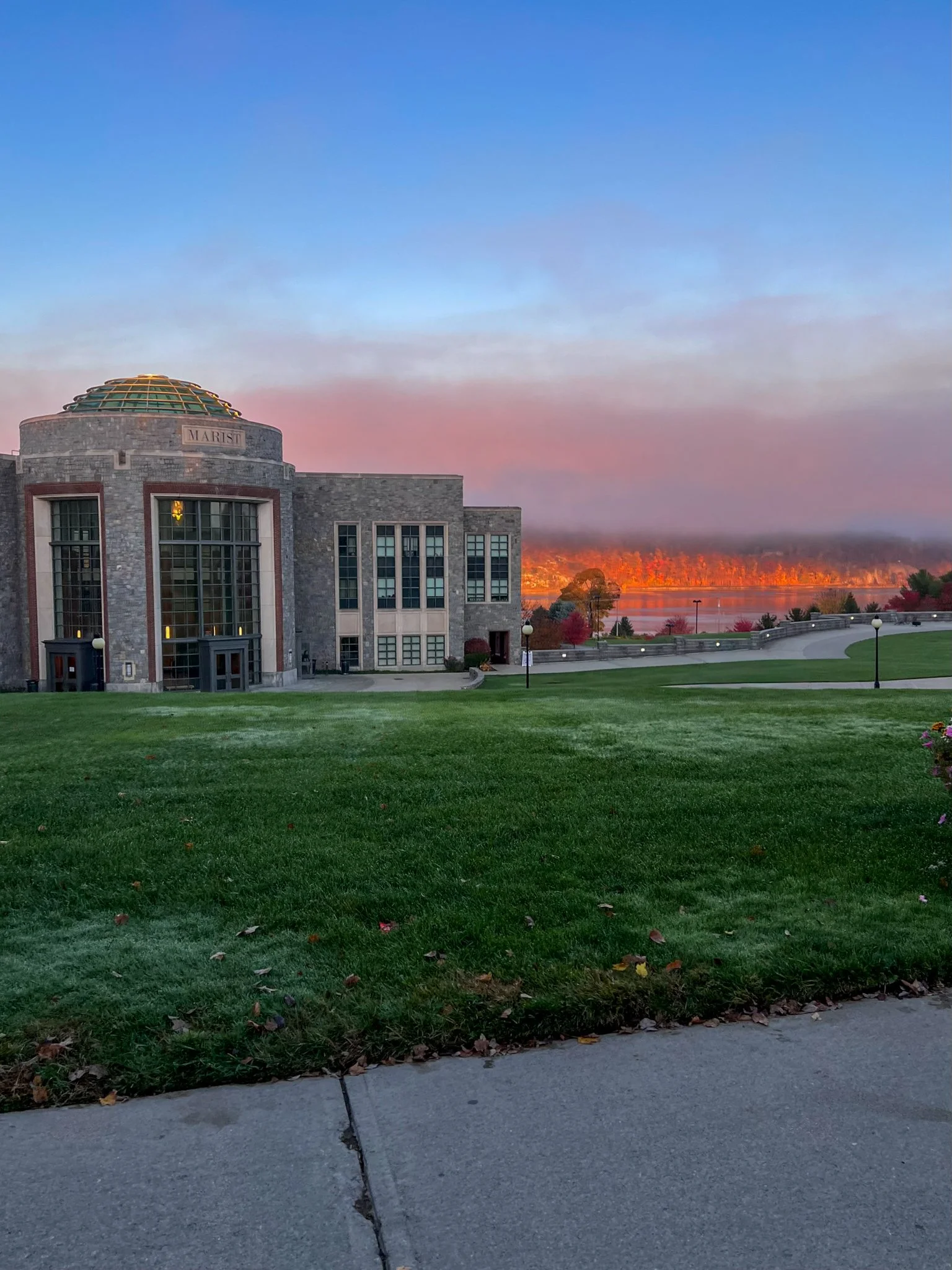
A Marist sunrise. Photo by Ava Battinelli '26
Two years after releasing the Marist 100 Strategic Plan, Marist University has taken a major step in implementing sustainable practices. The Sustainability Action Plan, a structured report for prioritizing sustainability on campus for years to come, was announced during the week of Dec. 1.
“[The plan] is more of a list of recommendations and goals, and this is essentially the first major step towards enacting the baselines and benchmarks for achieving future responsible function for the campus at large,” said Mike Eggert, general manager of the dining hall.
The plan is the product of a two-year process led by a 19-member Sustainability Action Planning Committee consisting of staff, faculty, alumni and students, all appointed by President Kevin Weinman. Dr. Jessica Boscarino, associate professor of political science, and Michael Caputo, vice president of Information Technology, acted as co-chairs of the team.
“We knew that we'd been doing a lot of things at Marist over the years that individual people on campus really cared about this issue and were taking action. But we never really had a plan,” said Boscarino. “We'd never really had coordinated efforts, and to make sure that this infused everything across campus.”
The Sustainability Action Plan is structured around four pillars: Education & Research, Energy, Greenhouse Gases, & Transportation, Buildings, Grounds, & Lands and Food, Water, & Waste, each with three to four specific goals for the future of Marist.
“Our goal was to make it as broad-based as possible so that it would take into account what students are learning in the classroom, how they're prepared for careers in sustainability, but also our daily operations,” said Boscarino.
“I think the education and research pillar would really, really help contribute to the culture of sustainable thinking on campus with community-based hands-on learning, and integrating sustainability across the curriculum and some of the coursework here on sites,” added Eggert.
While the plan outlines steps and initiatives to be taken in the coming years, one of the first steps is to compile a comprehensive baseline study of Marist’s emissions in order to have a place to start in terms of setting goals for reductions.
“We're going to need to engage an outside consulting firm to kind of look at every aspect of ways that we're creating impact on the campus, so that it's going to be a big undertaking because we've never done that before,” Boscarino explained. “But as I said, it's the necessary first step. So that's a big thing.”
Another big step will be identifying who is going to be in charge of implementing the strategies that are outlined in the plan on campus. President Weinman expressed that those who formed the plan should not necessarily be those implementing it, so whether Marist will appoint a dedicated administrator, hire outside experts or build a hybrid model is still under discussion.
“Some of the goals are lofty, and some of them are not necessarily measurable, but it's about putting the best foot forward,” said Eggert.
While there is much to come, Marist has already begun implementing some of these practices. For example, transitioning to using electric vehicles and exploring the use of alternative energy sources, among others.
Eggert also shared some of the dining hall’s efforts, such as achieving zero food waste, improving water conservation and quality and expanding recycling, composting and waste reduction.
“It's not like we're going to do this first, and then that next, and then this,” said Boscarino. “It's sort of each year we're going to have to see what makes sense to do for that year and where the budgets are, but some things are not going to cost any money, so those can be done right away. And some of them are already happening, and it's maybe just letting people know that we're doing those things.”
The committee started by seeing what other schools were doing to implement sustainable practices on their campuses, and ultimately shaped the plan to fit Marist.
Boscarino said, “During our very first meeting with Weinman, when he sent us off, he said to us, ‘Think big, I want you to think big.’ And so that's both freeing, but also, where do you start? We had a million ideas. So how do you call them down, or how do you organize them, or how do you prioritize them?”
Despite many members of the committee not having extensive experience in specific areas regarding sustainability, instead of thinking of it negatively, Eggert described this as “liberating.”
“I think it's more along the lines of, ‘Let's shine a light and let's start to follow it, and see where we can lead,’” said Eggert. “But really, I think it needs to be ground up and top down to really imbue an understanding of where we need to get as a campus collective to drive positive change.”