Marist Theatre Presents ‘The Curious Incident of the Dog in the Night-Time’
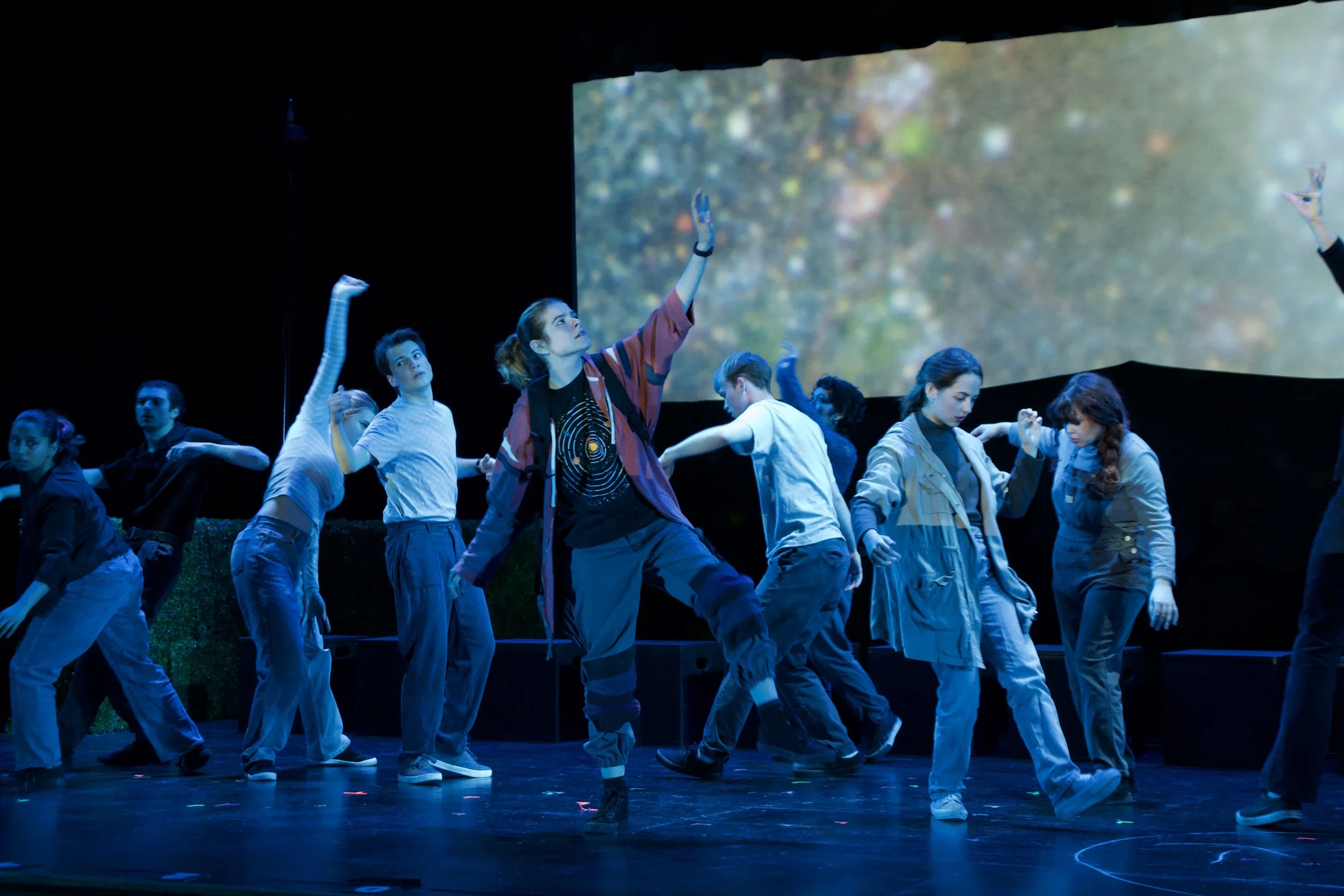
Marist University students performing The Curious Incident of the Dog in the Night-Time. Photo by Alexis Ucci '29
The Marist Theatre Guild opened its 2026-27 season with a performance of “The Curious Incident of the Dog in the Night-Time,” written by Simon Stephens and directed by Marist University adjunct professor Christine Crawfis. The show ran in the Nelly Goletti Theatre from Oct. 22-25.
Eileen Curley, professor of English and theatre, served as the Scenic and Projection Designer for “Curious Incident.” When asked about how “Curious Incident” became the choice to become the first production of the season, Curley said, “This show came up for it’s not sort of straightforward realism. It’s a different kind of acting and a different kind of production. We also thought it would be good to foreground a neurodivergent and the way that they experience the world because we haven’t done that in a while”.
“Curious Incident” is based on the 2003 novel of the same name by Mark Haddon, before being adapted into an award-winning play by Simon Stephens in 2012. While the story of a unique boy exploring the world around him while investigating a murder was originally told in first person, the play adaptation changed the presentation into a play-within-a-play. Both versions of the story received high praise and awards within their mediums.
The play follows 15-year-old Christopher Boone (El Raiford ‘27), who discovers his neighbor’s dog fatally stabbed with a garden fork. Though he has an extraordinary brain and talent for mathematics, Christopher is ill-equipped to interpret everyday life. Despite this and the warnings of his father Ed Boone (Andrew Schindler ‘30), Christopher resolves to investigate the murder of Wellington the dog, and embarks on a journey that turns his world upside-down.
“Curious Incident” is a show with many entertaining and funny moments, but contains an overall heavy tone that covers significant social themes including child abandonment, parental abuse and both conscious and unconscious ableism in society. “We’re hoping audiences will enjoy it and we’re hoping that they leave with a better understanding of what the character is going through in their life,” said Curley.
A commendable aspect of the show production is the impressive variety of students involved from all different groups in the Marist University community. The play boasts 14 members of the class of 2030, both on stage and on the backstage production team. The theatre takes pride in how involved the students are, and how much of a community that the students have built.
“Many of them are not actually theatre students,” Curley said. “We’ve got technical theatre staff majoring in sports communication, we have a few who are majoring in various computer science or math majors. They come from all over, but they have a shared love of doing theatre.”
The show featured an impressive ensemble cast of students who made each scene come to life with a revolving cast of characters and quick stage shifts that gave the show a one-of-a-kind visual style. Along with the cast, the show was also enhanced by projections on a large screen, elaborate props and the addition of one special cast member who tied the show together, Walter the dog.
“There’s two shows the faculty work on and then there’s four shows that the students do entirely on their own, everything is student driven,” Curley said. “This particular generation of students knows what they’re doing. They support each other, they work well with each other and they’ve got all kinds of inherited wisdom from the folks who have graduated recently, so they’re doing really great work.”