Marist to Administer Two Major Student Surveys Focused on Wellness and Academic Experience
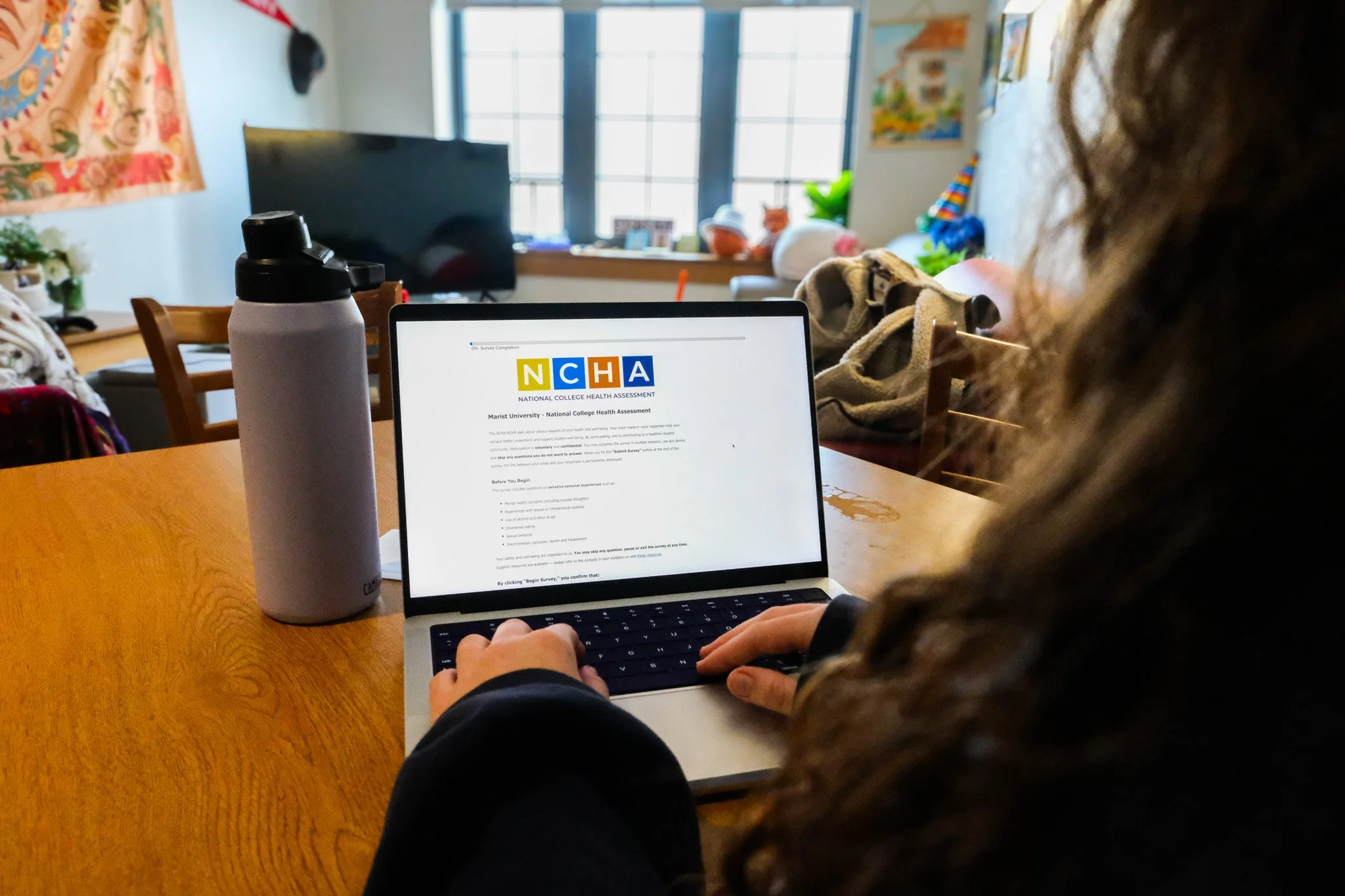
Marist is launching two student surveys to analyze student satisfaction and well-being to improve the Marist experience. Photo by: Ava Battinelli '26
Marist University will be rolling out two campus-wide surveys this semester to take a closer look at student experience and well-being. The surveys align with Marist’s broader institutional priorities of student centrality and long-term academic success.
The surveys will provide the administration with a more comprehensive snapshot of students’ lives, rather than relying on limited interactions or anecdotal observations.
The first survey, released on Feb. 3, is the Campus Wellness survey from the Health Services office. This survey is administered using the National College Health Assessment (NCHA), a tool commonly used by colleges and universities across the country. The survey collects data on a wide range of student experiences, such as nutrition, sleep, exercise, mental health and more.
“The survey gathers data on a wide range of student experiences and behaviors that affect their well-being,” Director of Health Services, Claudia Zegans, explained. “And we know that well-being is directly connected to student success.”
This survey is wide-ranging, as it is available to students 18+, in the hopes of better understanding the many factors that contribute to student well-being.
The survey remains confidential, so students can feel comfortable in being honest in their responses. This also means that the results will be evaluated at the population level rather than at the individual level. Zegans explained that this will help guide future programming across the university and determine whether existing initiatives are meeting students' needs.
In addition to the standard questions provided by the NCHA, Matrist also added a small set of validated questions on student gambling, per the athletic department's recommendation.
“We know that's an increasing problem. The data tells us in some of the studies that as much as 30 to 40% of students are engaging in some kind of gambling. And a significant percentage of those are problem gambling,” Zegans explained.
The survey has been well-received across campus so far, with about 6% of the student population responding in the first two days. The school expects a 20% response rate. With about two weeks left in the survey period, Health Services is doing everything it can to reach its goal.
“We are tabling all three weeks, in front of health services and around campus [...] to keep the survey at the front of students' minds and encourage participation,” Zegans explained.
When a student completes the survey at one of these tabling events, they will receive a fun giveaway, such as a hat, keychain or tumbler. After completing the survey, students are also entered for a chance to win a Nintendo Switch, a pair of AirPods or an exclusive Marist Red Fox Lego set.
In addition to the wellness survey currently underway, Marist will administer the National Survey of Student Engagement (NSSE). Unlike the wellness survey, NSSE focuses on how students, particularly college seniors and first-year students, are engaging with their academic experience.
“Since this survey is [conducted] through a reputable national organization and has thousands of participating students every year... we can get good benchmarking data,” explained Andrea Conner, vice president of Student Affairs.
The survey categories include information on a student’s participation in education, institutional requirements, perceptions of the college environment, personal estimates of growth and background and demographic information. Marist has also opted to add two additional modules in academic advising and career preparation.
Conner also explained that the survey is administered only to first-year students and seniors to capture perspectives on the major focal points of a student’s journey.
“This survey is designed to be administered at the end of the first year, to help us get a snapshot of how things are going for students and intervene if necessary,” Conner said. “So if we get data that indicates something troubling, or something that we could really do a lot better on. We have the opportunity to intervene before they graduate and then measure their results, as they graduate, to see if our interventions did any good.”
Conner acknowledged that some students, especially seniors, may be skeptical about whether the survey will actually lead to meaningful change and urged students to reach out with any questions about what will happen with the information.
“I want to earn the trust of the student body by making sure we do something with the data... I want to make good on [students taking the time to take the survey] by ensuring that campus leaders review the data and explore what to do with the data,” Conner emphasized.
Once available, the university plans to review the findings with campus leadership and share the outcomes with the Marist community. Conner explained that if the data shows a gap, it will indicate where it is most important to invest.
Students will be notified in late March to participate in the NSSE, and the survey will be open through April. This survey, too, will be incentivized to build excitement and collect more responses.
When asked whether the administrators were concerned that incentivization might lead to an influx of inaccurate responses, both Zegans and Conner gave the same response. They would much rather attract more responses and risk ‘slight dishonesty’ than risk fewer people taking it seriously.
As the semester continues to grow busier, the university is urging eligible students to participate in both surveys to help better the Marist community going forward.