Land of the Free, Home of the Illiterate
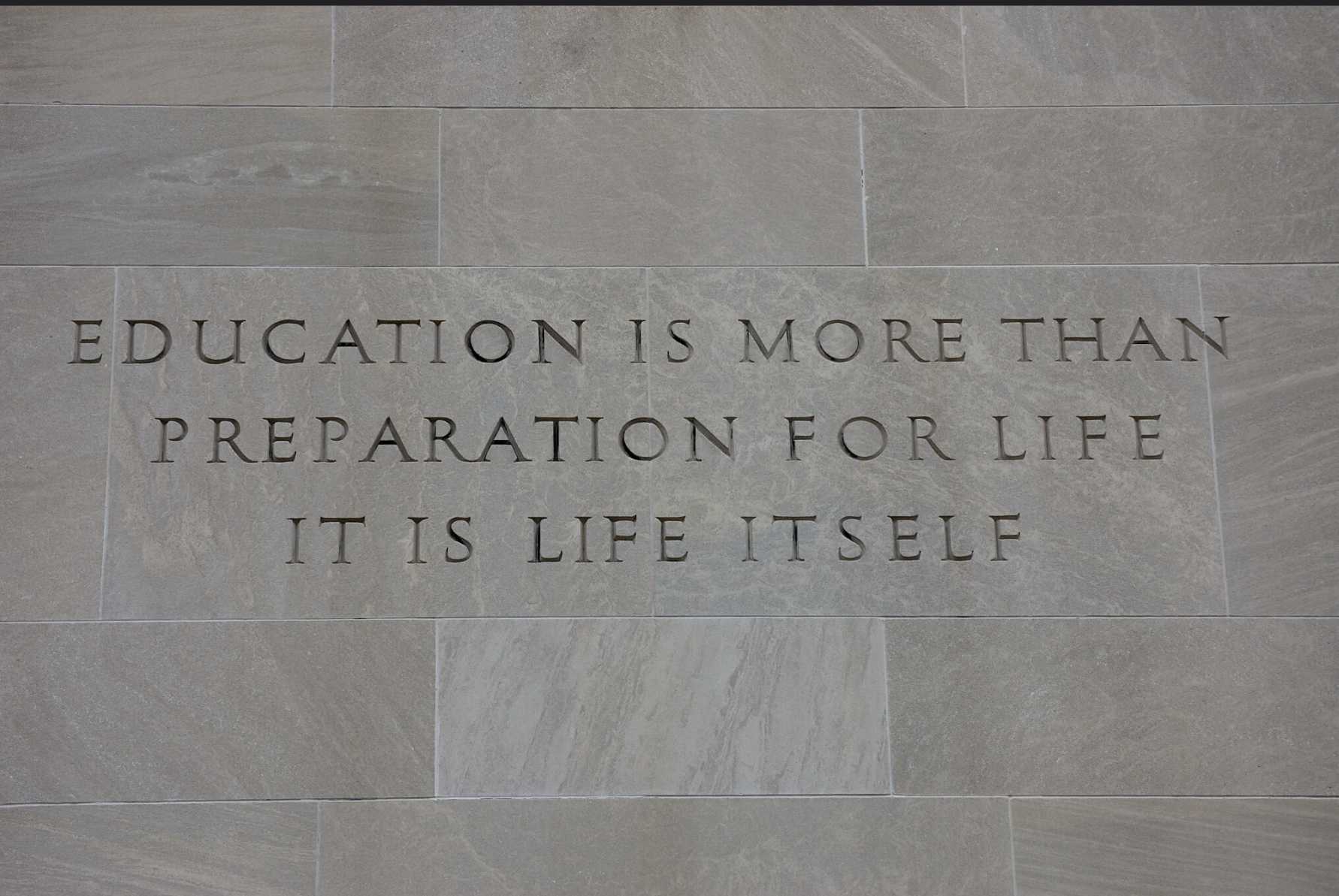
"Education is more than preperation for life, it is life itself" quote by John Dewey. Photo by Benjamin Golub, bgloub, on Flickr
Routine is necessary to human nature. We are first introduced to routine the moment we enter our first educational building as children, whether it be preschool or elementary school. We learn manners, we learn to socialize, but overall we are meant to receive basic educational skills.
Despite this, a multitude of teachers have come forward stating their distress over the fact that their students are being moved to the next grade level despite their inabilities to comprehend and perform basic skills such as reading, writing and question comprehension.
Educators are experiencing burnout and emotional stress due to the fact that they are unable to do their jobs properly in an education system that consistently pushes testing and refuses to do anything but throw students into the cogs of their ever-churning machine that pumps out graduates who are not qualified to possess their diplomas.
Many educators blame our current reality on the No Child Left Behind Act. The No Child Left Behind Act (NCLB) was originally implemented in 2001 by former President George W. Bush. This act aimed to improve students’ educational performance and close the achievement gap, overall prioritizing test scores over legitimate comprehension, making it an educator’s nightmare.
The NCLB Act remained in effect until 2015 when it was replaced with the Every Student Succeeds Act (ESSA). Under the ESSA, schools must set their own goals and standards, while holding schools accountable for student performance. The ESSA shifted the power from the federal government to the states, resulting in stagnant or declining test scores and educational inconsistency.
Enforcing NCLB and ESSA has resulted in educators teaching students how to take exams and achieve an unrealistic goal of 100% proficiency at the same time. This, in turn, has made it so students memorize short-term information to achieve an adequate grade, or simply disregard their grades as a whole since they are aware they will be pushed onto the next level to solidify the “100%” proficiency facade.
However, these acts aren’t the sole factors to blame for America’s educational decline. Studies have shown that an increase in screen time and digital distractions along with funding inequities, staff shortages and long-lasting effects of the pandemic have all contributed to learning recession amongst the American youth.
The National Assessment of Educational Progress (NAEP) shows in recent data that “about 31% of 4th graders, 30% of 8th graders and 35% of 12th graders were considered proficient or advanced in reading in 2024.” If these statistics disturb you, you aren’t the only one.
Recently, Texas public school teacher Darius Williams uploaded a video to social media of him weeping in distress for his English students. Williams claims that his 17- and 18-year-old students had been left functionally illiterate by their schools and parents, as they are unable to formulate simple sentences and paragraphs. This, in turn, has made Williams fear for their future.
Williams’ experience as a current educator raises the question of whether future educators, such as those here at Marist University, share his concerns.
“As someone going into language learning, it’s concerning seeing students not have the foundation in their first language,” said Owen Whelan ‘27, an adolescent/Spanish education major. “That’s something you lean on when building up a second one. Students should be literate in their first language but also need the confidence to start building up from there.”
Teaching is a work of the heart. Educators take pride in their profession and the impact they can — and will — leave on their students. How are we supposed to expect teachers to express their passion in a compelling manner and educate America’s youth if America is allowing said youth to move on to the next step even while ill-prepared? There is only so much educators can do, especially when so much is against them. So, I ask: When will America side with the teachers who mold the minds of the nation’s future? When will the future of our youth become a priority? When?